Introduction Proper installation is the single most important factor in cooling tower performance and longevity. A correctly erected and commissioned cooling tower will operate at design capacity for 15-20 years with routine maintenance. An incorrectly installed tower — even with perfect equipment — will suffer from premature component failure, reduced cooling capacity, and excessive water consumption. This guide covers the complete installation and commissioning process for industrial FRP (fiberglass-reinforced plastic) cooling towers, from site selection through to live operational testing. Site Selection and Preparation Before the cooling tower arrives, the foundation location must be carefully selected. Correct site selection prevents operational problems that cannot be corrected during commissioning. Location requirements: Adequate airflow: Position the tower where it can draw fresh, unrestricted air. Do not install in enclosed courtyards or close to walls higher than the tower air intake. Minimum clearance from walls: 1x the tower width on the intake side, 0.5x the width on other three sides. Away from heat sources: Do not locate near exhaust stacks, boiler houses, or other cooling towers where hot discharge air can recirculate. Structural support: The foundation must carry the full operating weight — including water fill, basin water, and dynamic loads from the fan motor. Operating weight for ZILLION ZL-CC series towers ranges from 190 kg (ZL-10T, dry) to 4,950 kg (ZL-600T, wet). Accessibility: Leave clearance for fan motor access, drift eliminator inspection panels, and water distribution maintenance. Minimum 1.5m above the fan deck for motor service. Water and drainage: Site must have makeup water supply and a suitable blowdown drainage point. Foundation and Structural Support The cooling tower foundation must be level, rigid, and capable of distributing the operating load uniformly. Concrete pad: Reinforced concrete pad, minimum 150mm thick, to manufacturer-specified dimensions. Level to within 3mm per metre. Anchor bolts: Install to the exact bolt pattern in the tower installation drawing. Bolt projection must engage the mounting bracket plus one nut and washer. Shims and grouting: Use stainless steel shims to achieve exact levelness after tower placement. Grout the entire base area with non-shrink cementitious grout — any void allows water accumulation and accelerated FRP basin corrosion. Multiple-tower installations: For parallel installations, ensure inlet and outlet pipework is sized for equal flow distribution to each tower. Mechanical Erection — Structural Assembly Step 1: Basin section placementLower the basin section onto the foundation, engaging anchor bolts. Use a spirit level — adjust with shims until level to 1mm across the full length. Tighten anchor bolts in a diagonal pattern, not sequentially. Step 2: Fill media installationInstall drift eliminators first, then fill media packs. For s...
Read MoreWhat Is a Cooling Tower and Why Does Sizing Matter? A cooling tower is a heat rejection device that cools water by evaporative cooling. In industrial settings — plastic injection molding, laser cutting, HVAC systems, and chemical processing — getting the tower size right is the difference between stable production and chronic overheating. Oversized towers waste money on purchase and running costs. Undersized towers cause process temperatures to exceed thresholds, leading to product defects, equipment stress, and unplanned downtime. This guide covers how to calculate your cooling load, interpret tower specifications, and select from the ZILLION ZL series range (10RT to 1000RT). How to Calculate Cooling Load for a Cooling Tower Step 1: Know Your Flow Rate and Temperature Differential Cooling Load (RT) = Flow Rate (m3/h) x DeltaT (C) x 0.239 Typical design conditions: Hot water inlet 37C, Cold water outlet 32C, Design wet bulb 27C, DeltaT 5C. Step 2: Convert RT to Tons 1 RT = 3,024 kcal/h. If removing 500,000 kcal/h: 500,000 / 3,024 = 165 RT. Select a tower rated above 165RT. Step 3: Check the Wet Bulb Temperature Cooling tower performance is limited by wet bulb temperature (WBT). A tower can only cool water to within 3-5C of WBT. ZILLION ZL Series Industrial Cooling Tower Range ZILLION cross-flow induced draft cooling towers, low-noise FRP casing, PVC fill, axial fan. Complete Specification Table Model Cooling Flow (m3/h) Motor Power (kW) Air Volume (CMM) Net Weight (kg) Operating Weight (kg) ZL-10T 7.81 0.37 85 46 190 ZL-15T 11.70 0.37 140 54 290 ZL-20T 15.62 0.55 160 67 300 ZL-25T 19.51 0.75 200 98 500 ZL-30T 23.40 0.75 230 116 530 ZL-40T 31.21 1.5 280 130 550 ZL-50T 39.20 1.5 330 190 975 ZL-60T 46.80 1.5 420 240 1,250 ZL-80T 62.60 1.5 450 260 1,280 ZL-100T 78.10 2.2 700 500 1,690 ZL-125T 97.50 2.2 830 540 1,640 ZL-150T 117.00 2.2 950 580 1,680 ZL-175T 136.80 4.0 1,150 586 1,960 ZL-200T 156.20 4.0 1,250 880 1,980 ZL-225T 175.50 5.5 1,500 1,050 2,770 ZL-250T 195.00 5.5 1,750 1,080 2,800 ZL-300T 234.00 7.5 2,000 1,760 3,930 ZL-350T 273.20 7.5 2,200 1,800 3,790 ZL-400T 312.10 7.5 2,400 2,840 5,740 ZL-500T 392.40 7.5 2,600 2,900 5,800 ZL-600T 468.00 11 3,750 3,950 9,350 ZL-700T 547.20 11 3,750 4,050 9,450 ZL-800T 626.40 15 5,000 4,700 11,900 ZL-1000T 781.20 15 5,400 4,900 12,100 Quick Selection by Application Application Typical Load Recommended Model Small injection molding (50-100T) 5-15 RT ZL-15T to ZL-25T CNC machining center 10-30 RT ZL-25T to ZL-50T Medium injection molding (200-350T) 40-80 RT ZL-80T to ZL-100T Large injection line (500-800T) 100-200 RT ZL-150T to ZL-250T Laser cutting machine (3-6kW) 15-40 RT ZL-30T to ZL-60T Industrial furnace cooling 200-400 RT ZL-300T to ZL-500T Plastic extrusion line 150-300 RT ZL-225T to ZL-400T Rubber mixing line 300-600 RT ZL-500T to ZL-700T Large-scale HVAC 500-1,000 RT ZL-800T to ZL-1000T Key Selection Criteria 1. Flow Rate Match: Tower flow rate must match your process chiller or equipmen...
Read More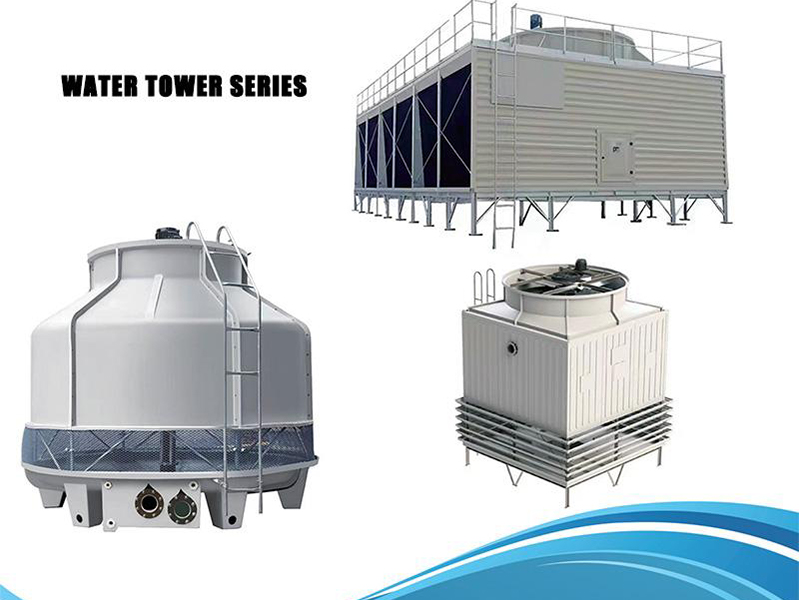
In industrial production, the cooling tower is a crucial equipment that provides efficient cooling solutions for many industries. The main function of the cooling tower is to exchange heat between hot water and air to cool the hot water and then recycle it. This cooling method not only saves water resources but also reduces energy consumption. In the power industry, cooling towers are widely used in the cooling systems of power plants. Generating sets will generate a large amount of heat during operation, and the circulating water needs to be cooled by the cooling tower to ensure the normal operation of the generating sets. The efficient cooling performance of the cooling tower can effectively reduce the temperature of the generating set, improve power generation efficiency, and prolong the service life of the equipment. The chemical industry is also one of the important application fields of cooling towers. In the chemical production process, many chemical reactions will generate a large amount of heat and need to be cooled in time. The cooling tower can quickly cool the hot water in the reaction kettle to ensure the smooth progress of the chemical reaction and improve product quality. In addition, cooling towers are also widely used in industries such as steel, metallurgy, pharmaceuticals, and food. In these industries, the cooling tower can not only provide cooling for production equipment but also provide a cold source for air conditioning systems and create a comfortable working environment for employees. There are many types of cooling towers. According to different application scenarios and needs, different types of cooling towers can be selected. For example, counterflow cooling towers, crossflow cooling towers, closed cooling towers, etc. Each type of cooling tower has its unique advantages and application scopes. In short, as an efficient cooling equipment, the cooling tower plays an important role in industrial production. It can not only save resources and reduce costs but also improve production efficiency and product quality, providing strong support for the sustainable development of enterprises.
Read More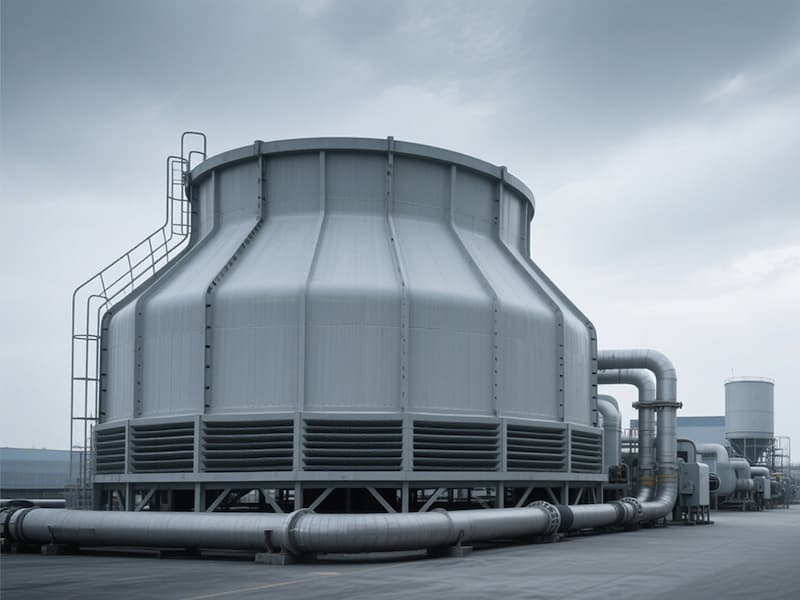
In an era of increasing environmental awareness and the need for sustainable industrial practices, the cooling tower industry is witnessing a surge in innovative solutions that combine efficiency, reliability, and eco-friendliness. These advancements are helping industrial facilities reduce their carbon footprint, lower operating costs, and meet strict environmental regulations. New Materials for Enhanced Performance One of the key areas of innovation is the use of advanced materials in cooling tower construction. Composite materials, such as fiberglass-reinforced plastic (FRP), are becoming increasingly popular due to their high strength, corrosion resistance, and lightweight properties. FRP cooling towers offer longer service life compared to traditional metal structures, reducing the need for frequent replacements and minimizing waste. Another promising material is high-performance plastics for fill media and drift eliminators. These materials are designed to improve heat transfer efficiency while reducing pressure drop, resulting in lower energy consumption. Additionally, they are more resistant to scaling and biological fouling, requiring less chemical treatment and reducing environmental impact. Smart Cooling Tower Technology The integration of smart technology is revolutionizing cooling tower operation and maintenance. Internet of Things (IoT)-enabled sensors can monitor key parameters such as water temperature, flow rate, fan speed, and energy consumption in real-time. This data is analyzed using advanced algorithms to optimize cooling tower performance, predict maintenance needs, and detect potential issues before they escalate. Smart cooling towers can also be integrated with building management systems (BMS) or industrial control systems, allowing for seamless coordination with other equipment and enabling proactive energy management. By adjusting operating parameters based on demand and environmental conditions, these systems can achieve significant energy savings, sometimes up to 20% compared to traditional cooling towers. Water Conservation Innovations Water scarcity is a growing concern in many regions, making water conservation a top priority for industrial facilities. New cooling tower designs incorporate features such as advanced drift eliminators that reduce water loss due to evaporation and wind drift. Some models also include water recycling systems that capture and reuse condensate and blowdown water, minimizing freshwater consumption. In addition, closed-circuit cooling towers are gaining popularity as they prevent water loss through evaporation by using a secondary coolant loop. These systems are particularly suitable for areas with strict water restrictions or where water quality is a concern. The Future of Sustainable Industrial Cooling As the demand for sustainable industrial solutions continues to grow, the cooling tower industry is poised for further innovation. Manufacturers are focusing o...
Read MoreIntroduction An air-cooled chiller is a refrigeration device that removes heat from process equipment using ambient air as the cooling medium. How Air Cooled Chillers Work Air-cooled chillers use fans to force ambient air across condenser coils containing refrigerant. The heat from the refrigerant is rejected to the air stream. Key Components The main components include the compressor, condenser coils with fans, evaporator, and expansion valve. Selecting the Right Size Chiller sizing depends on heat load, desired coolant temperature, and ambient conditions. Always consult with a specialist. Applications Air-cooled chillers are widely used in plastics processing, laser cutting, medical设备, and food processing.
Read More

Our company's series of products are well-known in the plastic auxiliary machinery industry for their excellent performance and high cost performance.


 IPv6 network supported


 English
  English
 español
 العربية