Air Cooled vs Water Cooled Industrial Chiller: How to Choose the Right Cooling System for Your Factory Selecting the right industrial chiller is one of the most consequential equipment decisions for any plastic processing, manufacturing, or industrial cooling application. The choice between an air cooled chiller and a water cooled chiller affects not only your upfront equipment investment, but also your long-term operating costs, maintenance requirements, and production flexibility. This guide breaks down exactly how air cooled and water cooled chillers differ, where each technology excels, and how to apply a systematic decision framework to select the right system for your specific application — whether you run an injection molding shop, an extrusion line, a blow molding operation, or a laser cutting facility. What Is an Industrial Chiller? An industrial chiller is a refrigeration system that removes heat from a process or equipment by circulating a cooling fluid — typically water or a water-glycol mixture — through a closed-loop circuit. The chiller compresses a refrigerant gas, condenses it under pressure, expands it to create a cold evaporation state, and absorbs heat from the process water circuit. The cooled fluid is then circulated through user equipment to absorb and remove unwanted heat. Industrial chillers are specified by their cooling capacity (measured in kW or RT — refrigeration tons), their energy efficiency ratio (EER), and their approach temperature — the difference between the chilled water supply temperature and the temperature required at the process. Air Cooled vs Water Cooled Chillers: Core Differences How Air Cooled Chillers Work Air cooled chillers reject heat from the refrigerant condensation process using ambient air drawn across a fin-and-tube heat exchange coil by one or more axial fans. The key components are: Scroll or screw compressor — compresses the refrigerant gas Air-cooled condenser coil — rejects heat to ambient air Evaporator — cools the process water circuit Expansion valve — reduces refrigerant pressure and temperature Air cooled chillers are self-contained units that require only an electrical connection and a process water circuit. They do not require a secondary water supply or a cooling tower. How Water Cooled Chillers Work Water cooled chillers reject heat from the refrigerant condensation process using a circulating water stream that carries the heat to a cooling tower, dry cooler, or heat exchanger. The key additional components are: Water-cooled condenser — exchanges heat from refrigerant to circulating cooling water Cooling tower or dry cooler — rejects heat from the condenser water to the atmosphere via evaporation or sensible cooling Condenser water pumps — circulates water between the chiller and the tower Water treatment system — prevents scale, corrosion, and biological growth in the condenser water circuit Head-to-H...
Read More# Water Chiller Supplier Guide 2026: How to Find a Reliable Industrial Chiller Manufacturer in China Table of Contents Why the Global Demand for Industrial Water Chillers Is Surging in 2026 What Is a Water Chiller — And Why It Matters for Your Business Air Cooled vs. Water Cooled Chillers: Which One Do Your Customers Actually Need Key Applications Driving Water Chiller Purchases in 2026 How to Evaluate a Chinese Water Chiller Supplier: The 10-Point Checklist ZILLION: Your Full-Range Water Chiller Manufacturing Partner Product Portfolio: Water Chiller Models for Every Cooling Demand Why International Buyers Choose ZILLION Over Other China Chiller Suppliers Frequently Asked Questions About Sourcing Water Chillers from China Ready to Source? Let's Talk 1. Why the Global Demand for Industrial Water Chillers Is Surging in 2026 The industrial cooling equipment market has never been more active. Three converging forces are driving demand across every major manufacturing region: Manufacturing reshoring and nearshoring — Factory construction in Southeast Asia, Mexico, and Eastern Europe is creating sustained demand for cooling equipment across new production facilities. Energy efficiency regulations — Stricter energy consumption standards in the EU, North America, and Asia-Pacific are accelerating the retirement of older, inefficient chiller systems and replacing them with higher-efficiency models. Advanced manufacturing growth — Laser cutting, PCB manufacturing, pharmaceutical production, and food processing each require precision temperature control that only modern water chillers can reliably deliver. For commercial buyers, distributors, and procurement managers, this means one thing: water chiller suppliers who can deliver consistent quality, competitive pricing, and reliable logistics are in higher demand than ever. The challenge? China manufactures over 60% of the world's commercial and industrial cooling equipment. Sorting through hundreds of Chinese water chiller suppliers to find a genuinely capable manufacturing partner is harder than it looks. This guide is designed to do exactly that — give you the framework to evaluate, compare, and select the right supplier with confidence. 2. What Is a Water Chiller — And Why It Matters for Your Business A water chiller is a refrigeration device that removes heat from a process or space by circulating chilled water through a closed-loop cooling system. Unlike air conditioning units that cool ambient air directly, water chillers use water as the heat transfer medium — making them far more efficient at handling high heat loads in industrial environments. The Core Components of a Water Chiller System Every industrial water chiller consists of four primary subsystems: Compressor — The heart of the chiller. Scroll compressors are standard in smaller units (2–30 HP); screw compressors dominate larger industrial systems (40–200+ HP). The compressor circul...
Read MoreAn industrial chiller is one of the most operationally critical pieces of equipment in any facility that depends on precision temperature control. When a chiller fails, process temperatures drift, quality suffers, and production slows. This guide covers the most common industrial chiller problems and their solutions. Understanding How Chillers Work: A chiller uses a refrigerant that cycles between four states: Compression (low-pressure gas compressed to high-pressure), Condensation (hot gas condenses to liquid in the condenser), Expansion (high-pressure liquid drops in temperature), Evaporation (cold refrigerant absorbs heat from process water). Problems in any stage affect cooling capacity. Problem 1: Chiller Fails to Start / No Power: Check main breaker and any branch circuit breakers. Verify power supply voltage at the connection terminal. If voltage is present but the unit is dead, internal fuse or control board is likely at fault. Problem 2: Insufficient Cooling Capacity: Process water temperature higher than setpoint. Common causes: refrigerant charge is low (leak), evaporator coils frosted, condenser coils dirty, scaling in process cooling lines. Check refrigerant pressure gauges and inspect condenser coils for debris. Problem 3: High Discharge Pressure: High-pressure alarm, chiller may cycle on and off on high pressure protection. Common causes: dirty or restricted condenser coils, inadequate cooling water flow, refrigerant overcharge, failed condenser fan motor. Problem 4: Low Discharge Pressure: Chiller runs continuously but cannot reach temperature setpoint. Common causes: insufficient refrigerant charge (leak), restricted refrigerant flow (blocked filter drier), failed expansion valve. Problem 5: Compressor Short Cycles: Compressor cycles on and off rapidly. Common causes: refrigerant overcharge, failed or stuck expansion valve, faulty compressor overload protector. Problem 6: Excessive Vibration or Noise: Unusual sounds from the compressor or fan area. Common causes: failed compressor mount isolation, loose fan blades, compressor internal failure. Internal compressor problems require immediate shutdown and service. Problem 7: Process Water Temperature Too High: Water leaving the chiller above setpoint. Common causes: chiller capacity insufficient for the load, hot refrigerant gas by-passing the evaporator, low refrigerant charge, evaporator pump failure. Problem 8: Water Pump Not Circulating: Low flow alarm, pump running but no pressure. Common causes: airlock in the pump or suction line, blocked strainer, failed pump seal, pump motor failure, closed isolation valve. Problem 9: Chiller Freezes Up: Frost or ice buildup on the evaporator coils. Common causes: low refrigerant charge, faulty defrost cycle, failed airside temperature sensor causing overcooling. Problem 10: Error Codes: Digital display shows error code. "HP" = high pressure, "LP" = low pressure, "FLO" = flow fault, "E-01" = sensor fault. Consult the manufacturer manual for...
Read MoreInside every laser cutting and welding machine, the most precise manufacturing technology in widespread use depends fundamentally on water cooling. The laser resonator, optics, and fiber delivery systems all generate significant heat that must be removed precisely and continuously for the laser to maintain power stability and beam quality. A laser chiller is not a luxury accessory — it is a core component of the laser system. Why Laser Equipment Needs Cooling Laser source (resonator): The heart of the laser generates significant waste heat. In fiber lasers and CO2 lasers, the efficiency of converting electrical input to laser light is typically 30-40% — the rest becomes heat that must be removed. Even small temperature changes in the resonator affect the laser wavelength and power output. Laser optics: Without cooling, thermal lensing occurs — optics change focal length as they heat, degrading cutting and welding precision. Fiber delivery system: Fiber optic cables can overheat if the coupling optics are not properly cooled. How a Laser Chiller Works Refrigeration system: Compressor, condenser, evaporator, and expansion valve — the same basic refrigeration cycle used in air conditioning. Circulating pump: Moves chilled water through the laser system cooling circuits at a controlled pressure and flow rate. Temperature controller: Maintains the chilled water at a precise setpoint (typically 20-25C). Temperature stability of +/- 1C or better is critical for laser power stability. Water reservoir: Provides a buffer volume to absorb thermal surges during intensive cutting/welding operations. Cooling Capacity: How to Size a Laser Chiller Sizing a laser chiller is not guesswork — laser equipment manufacturers specify the maximum heat load that must be removed. 500W fiber laser: approximately 1.5-2.5 kW cooling required. 1,000W fiber laser: approximately 3-5 kW cooling required. 2,000W fiber laser: approximately 6-10 kW cooling required. 4,000W fiber laser: approximately 12-18 kW cooling required. An undersized chiller cannot remove heat fast enough. An oversized chiller cycles on and off more frequently, reducing compressor life and causing temperature instabilities. Air-Cooled vs Water-Cooled: Air-cooled uses a fan to blow air across condenser coils — simpler installation, suitable for environments where ambient temperature is moderate (under 35C). Water-cooled uses a secondary water supply (cooling tower or city water) — more efficient in high-ambient-temperature environments, lower operating noise, but requires additional infrastructure. Why Tap Water Is Not Acceptable: Scale formation from calcium and magnesium deposits reducing cooling efficiency. Corrosion of aluminum and copper cooling channels from dissolved oxygen and minerals. Algae and biofilm clogging filters and reducing flow. No temperature precision — a water loop without refrigeration cannot maintain the +/- 1C stability required. A laser c...
Read More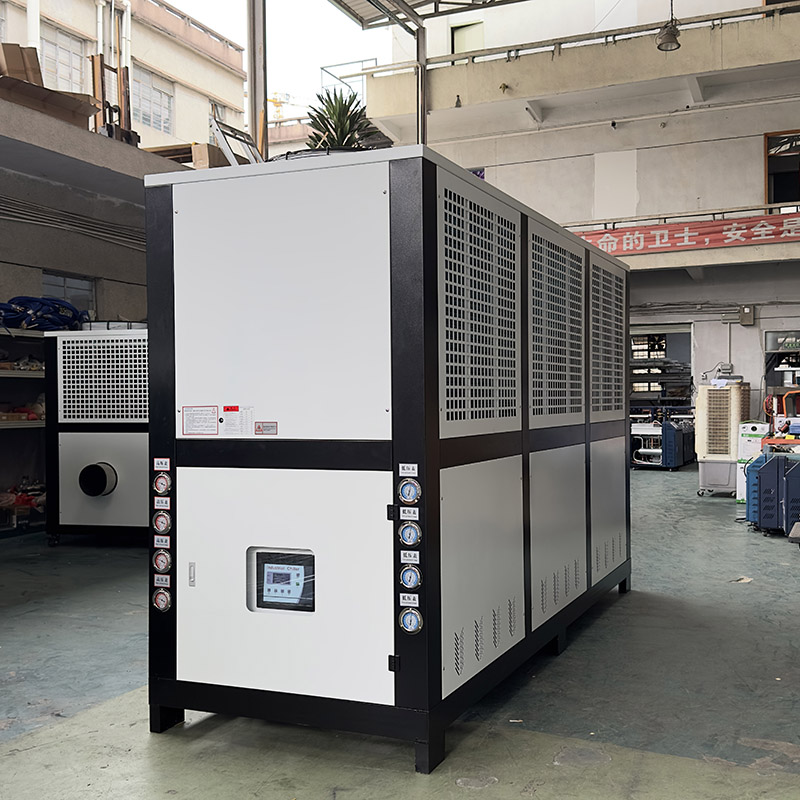
In the field of food production, temperature control is a key link determining product quality, safety, and shelf life. From raw material processing to finished product packaging, temperature fluctuations in any link may lead to food spoilage, decreased taste, or microbial growth, bringing huge economic losses to enterprises. The 50HP air-cooled chiller has become an ideal choice for many food production enterprises to achieve constant temperature production due to its stable refrigeration performance, precise temperature control ability, and energy-efficient advantages. As a high-power refrigeration equipment, the core advantage of the 50HP air-cooled chiller is its ability to provide continuous and stable cooling supply for large-area food production workshops. This equipment adopts advanced air-cooled condensation technology, which does not require a cooling water tower, is convenient and flexible to install, and is not limited by on-site water sources, making it particularly suitable for the complex layout environment of food production workshops. At the same time, the equipment is equipped with a high-precision temperature control system, with a temperature control accuracy of ±1℃, which can accurately meet the strict temperature requirements of different food production processes. It can easily handle both low-temperature refrigerated meat processing workshops and medium-temperature fresh-keeping fruit and vegetable processing workshops. ----------------------------- Food is highly sensitive to temperature during production. Taking baked food production as an example, the dough fermentation stage requires a stable temperature environment. Too high or too low temperature will affect the fermentation effect of the dough, leading to rough taste and poor shape of the finished product; in dairy production, if the temperature control is improper during the cooling link after sterilization, it is easy to breed harmful microorganisms and affect product safety. The 50HP air-cooled chiller can continuously maintain a constant temperature in the production workshop, effectively inhibit the growth and reproduction of microorganisms, ensure that food is in the best temperature state in each production link, guarantee food quality and safety from the source, and reduce the risk of product spoilage caused by temperature fluctuations. ----------------------------- Improve Production Efficiency, Reduce Operating Costs Traditional refrigeration equipment often has problems such as low refrigeration efficiency, high energy consumption, and high failure rate, which not only affect the production progress but also increase the operating costs of enterprises. The 50HP air-cooled chiller adopts an efficient compressor and an optimized heat exchange system, which greatly improves the refrigeration efficiency. It can quickly reach the set temperature and maintain stability, reducing the start-stop frequency of the eq...
Read More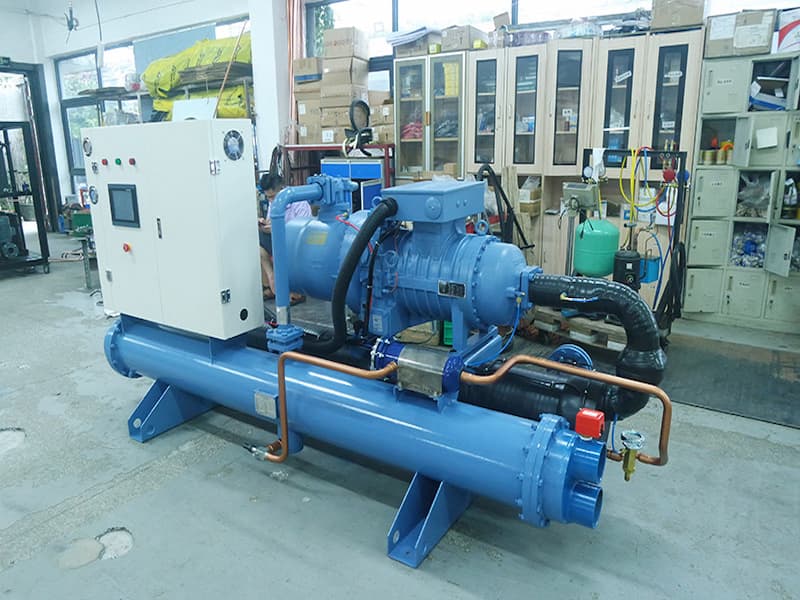
Introduction In an era where industrial efficiency and sustainability are paramount, maintaining precise temperature control is non-negotiable for processes ranging from manufacturing to data management. Traditional cooling systems often fall short in delivering consistent performance, energy savings, and adaptability—challenges that screw chillers have uniquely addressed. As the backbone of modern industrial cooling, screw chillers combine robust engineering, energy-efficient design, and versatile functionality to meet the evolving needs of diverse industries. This article explores why these systems have emerged as the ultimate solution for businesses seeking reliable, high-performance cooling. How Screw Chillers Work: The Mechanics of Efficient Cooling At the core of a screw chiller lies its namesake component: the twin-screw compressor, a marvel of mechanical engineering designed for seamless refrigerant compression. The system operates through four key stages in the vapor-compression refrigeration cycle: Compression:The twin-screw compressor—featuring interlocking male (convex) and female (concave) rotors—draws in low-pressure refrigerant vapor. As the rotors rotate, they reduce the volume of the vapor, increasing its pressure and temperature before discharging it to the condenser. Condensation:The high-pressure vapor enters the condenser, where it releases heat to a cooling medium (water or air), transforming into a liquid. This stage rejects excess heat generated by industrial processes, ensuring ambient temperatures remain stable. Expansion:A thermal expansion valve or capillary tube reduces the pressure of the liquid refrigerant, causing it to vaporize at a lower temperature as it enters the evaporator. Evaporation:In the evaporator, the low-pressure refrigerant absorbs heat from the target environment (e.g., chilled water or air), converting back to vapor. This cooled medium is then circulated to maintain the desired temperature in the facility, completing the cycle. Key components like variable frequency drives (VFDs) and intelligent control systems optimize this process, adjusting output in real time to match fluctuating cooling demands. Unmatched Advantages of Screw Chillers 1. Exceptional Energy Efficiency Screw chillers lead the industry in energy savings, particularly under partial loads—a common scenario in most industrial settings. Their variable capacity control (via slide valves or VFDs) allows output to scale from 10% to 100% of rated capacity, minimizing energy waste. Modern models achieve integrated part-load values (IPLV) as high as 12.0, significantly outperforming reciprocating or centrifugal chillers. This efficiency not only lowers operational costs but also aligns with global sustainability goals, reducing carbon footprints. 2. Robust Reliability and Longevity With fewer moving parts than reciprocating compressors (no pistons, valves, or crankshafts), screw chillers experience minim...
Read More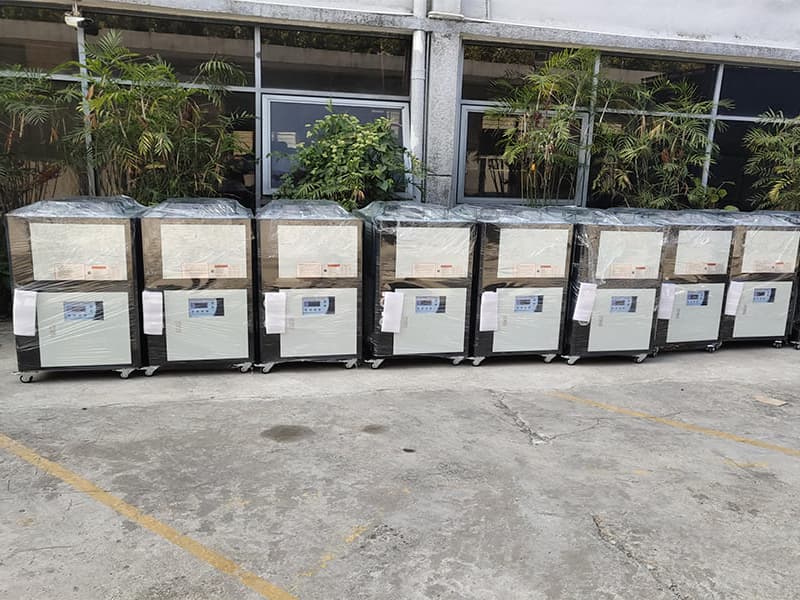
In modern industrial and commercial fields, air-cooled chillers have become an ideal cooling equipment in many application scenarios due to their unique advantages. Air-cooled chillers do not need cooling towers and are easy to install, suitable for various environments with limited space. For places without sufficient water sources or where it is inconvenient to install water towers, air-cooled chillers are undoubtedly the best choice. In industrial production, air-cooled chillers are widely used in industries such as plastic processing, chemical industry, and electronics. In the plastic processing process, it can quickly cool injection molds to ensure the dimensional accuracy and surface quality of plastic products. In the chemical industry, air-cooled chillers can provide a stable low-temperature environment for chemical reactions to ensure the smooth progress of reactions and product quality. The electronics industry has extremely high requirements for temperature control. Air-cooled chillers can precisely control the operating temperature of equipment to prevent electronic components from being damaged due to overheating. In the commercial field, air-cooled chillers are often used in central air conditioning systems. It can provide comfortable indoor temperatures for large shopping malls, office buildings, hotels and other places. At the same time, air-cooled chillers operate stably and have low noise, and will not cause excessive interference to the surrounding environment. In addition, air-cooled chillers also have the characteristics of energy saving and high efficiency. Its advanced compressor and optimized system design can reduce energy consumption while ensuring the cooling effect, saving operating costs for users. In short, air-cooled chillers have become an indispensable cooling equipment in modern industrial and commercial fields with their advantages of easy installation, wide application range, energy saving and high efficiency.
Read MoreWhy Choosing the Right Air Cooled Chiller Matters for Plastic Manufacturing Air cooled chillers are among the most widely used cooling solutions in plastic manufacturing facilities worldwide. Unlike water cooled systems, air cooled chillers reject heat into the surrounding air without requiring a separate cooling tower or condenser water system, making them simpler to install, easier to maintain, and ideal for facilities where water resources are limited. Selecting the right air cooled chiller is not just about matching the unit's nominal cooling capacity to your machine nameplate. It requires a deeper understanding of your process heat load, desired coolant temperature, ambient conditions, and operational patterns. Step 1: Calculate Your Actual Cooling Load In plastic processing, the cooling load comes from part cooling, cylinder radiation (15-30% of total), hydraulic oil heat, and motor heat. A practical shortcut: estimate 0.8-1.2 kW per ton of cooling capacity for general-purpose injection molding. Precise formula: Cooling Load (kW) = Mass (kg/h) x Cp x (T_melt - T_eject) / 3600 Step 2: Determine the Required Leaving Water Temperature Different plastic processes demand different temperatures: Standard injection molding (10-25C), Thin-wall high-speed molding (5-15C), Extrusion and blow molding (15-30C), Rubber molding (40-80C, requires MTC not chiller). The chiller's leaving water temperature must be lower than the process dew point. Step 3: Evaluate Ambient Conditions For every 1C rise above 35C design temperature, chiller capacity drops 1.5-2% and power consumption rises ~1%. Size the chiller with 10-15% safety margin for high summer temperatures. At elevations above 1,000m, apply a correction factor of 1.5% per 100m. Step 4: Match Compressor Type to Your Application Scroll compressors: Most common for plastic applications - excellent reliability, quiet operation, good part-load efficiency. Piston compressors: Suitable for smaller capacities with frequent on-off cycling. Screw compressors: Used above 50kW - can modulate capacity, ideal for plants with multiple machines. Step 5: Check Flow Rate and Pressure Requirements Ensure the chiller pump delivers sufficient flow (0.15-0.25 L/min per kW of cooling capacity) against total system pressure drop. Maintain a Delta-T of 3-6C between chiller supply and return water for stable temperatures. Step 6: Consider Energy Efficiency Features Variable speed fans (EC fans) reduce energy consumption by up to 30% in partial-load conditions. Capacity modulation via inverter-driven compressors eliminates wasteful on-off cycling. Modern microprocessor controls allow easy temperature setting and alarm management. Step 7: Sizing Example 3 injection molding machines, each 20kW cooling load, 40C ambient, 15C leaving water required. Total load = 60kW. With 15% safety margin = 69kW. An 85-90kW air cooled chiller with scroll compressors provides comfortable headroom. Conclusion Choosing the right air cooled chiller re...
Read More

Our company's series of products are well-known in the plastic auxiliary machinery industry for their excellent performance and high cost performance.


 IPv6 network supported


 English
  English
 español
 العربية