Inside every laser cutting and welding machine, the most precise manufacturing technology in widespread use depends fundamentally on water cooling. The laser resonator, optics, and fiber delivery systems all generate significant heat that must be removed precisely and continuously for the laser to maintain power stability and beam quality. A laser chiller is not a luxury accessory — it is a core component of the laser system. Why Laser Equipment Needs Cooling Laser source (resonator): The heart of the laser generates significant waste heat. In fiber lasers and CO2 lasers, the efficiency of converting electrical input to laser light is typically 30-40% — the rest becomes heat that must be removed. Even small temperature changes in the resonator affect the laser wavelength and power output. Laser optics: Without cooling, thermal lensing occurs — optics change focal length as they heat, degrading cutting and welding precision. Fiber delivery system: Fiber optic cables can overheat if the coupling optics are not properly cooled. How a Laser Chiller Works Refrigeration system: Compressor, condenser, evaporator, and expansion valve — the same basic refrigeration cycle used in air conditioning. Circulating pump: Moves chilled water through the laser system cooling circuits at a controlled pressure and flow rate. Temperature controller: Maintains the chilled water at a precise setpoint (typically 20-25C). Temperature stability of +/- 1C or better is critical for laser power stability. Water reservoir: Provides a buffer volume to absorb thermal surges during intensive cutting/welding operations. Cooling Capacity: How to Size a Laser Chiller Sizing a laser chiller is not guesswork — laser equipment manufacturers specify the maximum heat load that must be removed. 500W fiber laser: approximately 1.5-2.5 kW cooling required. 1,000W fiber laser: approximately 3-5 kW cooling required. 2,000W fiber laser: approximately 6-10 kW cooling required. 4,000W fiber laser: approximately 12-18 kW cooling required. An undersized chiller cannot remove heat fast enough. An oversized chiller cycles on and off more frequently, reducing compressor life and causing temperature instabilities. Air-Cooled vs Water-Cooled: Air-cooled uses a fan to blow air across condenser coils — simpler installation, suitable for environments where ambient temperature is moderate (under 35C). Water-cooled uses a secondary water supply (cooling tower or city water) — more efficient in high-ambient-temperature environments, lower operating noise, but requires additional infrastructure. Why Tap Water Is Not Acceptable: Scale formation from calcium and magnesium deposits reducing cooling efficiency. Corrosion of aluminum and copper cooling channels from dissolved oxygen and minerals. Algae and biofilm clogging filters and reducing flow. No temperature precision — a water loop without refrigeration cannot maintain the +/- 1C stability required. A laser c...
Read MoreA mold temperature controller that worked fine yesterday and suddenly fails to reach temperature this morning can shut down an entire production line. This guide covers the most common mold controller failures and what a qualified technician can do to resolve each one. Problem 1: Controller Fails to Heat Symptoms: Mold temperature remains at ambient despite controller showing "heating" status. Root causes: heating element failure (burned out heater), loose electrical connection at heater terminal, tripped thermal overload relay, failed temperature sensor, closed isolation valve. Floor fixes: check isolation valves are fully open, check circuit breaker and thermal overload relay, inspect electrical connections at heater terminals. Problem 2: Mold Temperature Too Hot (Over Temperature) Symptoms: Mold temperature exceeds setpoint and continues rising. Root causes: cooling water not flowing (closed valve, water supply failure), fouled cooling channels in the mold, failed cooling valve, temperature sensor out of calibration, cooling water temperature too high. Problem 3: Mold Temperature Fluctuates Unstably Symptoms: Controller cycles rapidly between heating and cooling, temperature oscillates +/- 5-10C around setpoint. Root causes: oversized heating capacity relative to mold thermal mass, poor flow rate, incorrect PID parameters, air in the heating/cooling circuit. Problem 4: High Temperature Alarm Symptoms: Controller display shows an error code, operation stops, alarm indicator lights. Root causes: overtemperature condition, temperature sensor short circuit or open circuit, controller internal fault, cooling system failure during heating mode. Floor fixes: allow mold to cool below alarm threshold, check cooling water supply, reset controller and restart. Problem 5: Low Flow Alarm or No Flow Symptoms: Controller displays flow alarm, pump runs but mold does not heat or cool effectively. Root causes: airlock in the circuit, clogged strainer or filter, closed isolation valve, pump failure, leaking connections. Problem 6: Controller Will Not Start / No Power Symptoms: Controller display is blank, machine does not respond to power switch. Root causes: power supply failure, failed power switch, internal fuse blown, control panel PCB failure. Preventive Maintenance: Weekly — check water/thermal fluid level, inspect for leaks, verify display accuracy. Monthly — clean strainers and filters, check electrical connections, verify cooling water flow rate. Quarterly — full system calibration check, inspect heating and cooling valves, test safety interlocks. Annually — comprehensive service by qualified technician, replace thermal fluid (oil systems), test and replace temperature sensors. Most mold controller problems have recognizable symptoms and traceable root causes. A systematic troubleshooting approach resolves the majority of issues without a service call. Need technical support? Contact Zillion: leika@gdzillion.cn
Read MoreMold temperature is one of the most critical variables in injection molding. It directly controls surface finish quality, dimensional accuracy, cycle time, and the mechanical properties of the finished part. Yet many molders treat the mold temperature controller (MTC) as a commodity purchase, choosing on price alone rather than matching the controller to the actual thermal requirements of the mold and material. Why Mold Temperature Matters Surface finish: Higher mold surface temperatures produce glossy, blemish-free surfaces. Low mold temperatures cause flow lines, weld lines, and silver streaks. Dimensional stability: Consistent mold temperature reduces part warpage and ensures dimensional tolerances. Cycle time: In some applications, higher mold temperatures allow faster injection speeds and shorter pack/hold times. Material properties: Some engineering resins (PC, Nylon, PBT) require high mold temperatures to achieve their rated mechanical properties. Water vs Oil: Which System Do You Need? Water mold temperature controllers offer temperature range up to 95-120C (pressurized). Best for general-purpose injection molding with standard materials (PP, PE, PS, ABS, PA6, PA66). Advantages: fast heating and cooling response, low cost, easy maintenance. Oil mold temperature controllers offer temperature range up to 200-300C. Best for high-temperature engineering resins (PC, PEI, PEEK, PPS), hot runner molds, compression molding. Advantages: higher maximum temperature, more uniform heat distribution. Limitations: slower response time, thermal fluid degradation, fire hazard. Key Specifications: Heating capacity (kW) determines how fast the controller can bring a cold mold up to temperature. Cooling capacity (kW) determines how effectively you can remove heat from the mold during production. Flow rate (L/min) determines how quickly heat is circulated through the mold cooling channels. Temperature stability (+/- C): typical ranges from +/- 1.0C to +/- 0.1C. Higher precision for engineering parts. Matching Controller to Mold: Small molds (under 300mm): compact water MTC with 6-12 kW. Medium molds (300-600mm): mid-size water MTC with 12-24 kW. Large molds (over 600mm): larger water or oil MTC with 24-36+ kW. High-temperature materials (PC, Nylon, PEI): oil MTC required above 120C. Common Selection Mistakes: Choosing by price alone — an undersized controller saves money on purchase but costs more in extended cycle times and quality defects. Ignoring cooling capacity — equally important as heating capacity. Not planning for mold changes — if you change molds frequently, oversized heating capacity pays for itself in reduced setup time. The mold temperature controller is one of the highest-leverage productivity tools in injection molding. The right controller, correctly sized, directly reduces cycle time, improves part quality, and minimizes startup waste. Need help selecting the right mold temperature controller? Contact Zillion: leika@gdzill...
Read MorePricing for industrial plastic crushers spans a range wider than most buyers expect — from under $1,000 for small workshop models to over $15,000 for heavy duty industrial systems. This range reflects genuine differences in construction quality, motor power, blade systems, and the applications each machine is designed for. 2025 Price Guide by Power Class Entry-Level (2.2-4 kW / 3-5HP): Capacity 120-250 kg/h. For small workshops, low-volume processing. Price range: $500-$1,200. Light Industrial (5.5-7.5 kW / 7.5-10HP): Capacity 300-500 kg/h. For small-to-medium production scrap. Price range: $800-$1,800. Medium Industrial (11-15 kW / 15-20HP): Capacity 400-800 kg/h. For medium-volume production scrap, multi-shift operations. Most common class for mid-size injection molding and extrusion plants. Price range: $1,500-$3,500. Heavy Industrial (22-30 kW / 30-40HP): Capacity 700-1,000 kg/h. For high-volume operations, heavy-walled materials. Price range: $3,000-$6,000. Extra Heavy Industrial (38-55 kW / 50-75HP): Capacity 1,000-2,500 kg/h. For industrial-scale recycling. Price range: $5,500-$15,000+. What Drives Price Differences? Motor brand: Siemens, ABB, and WEG motors command a premium but deliver better thermal performance and longer bearing life in continuous operation. Blade system: SKD-11 blade kits cost more upfront but blade replacement frequency drops by 50-70% in heavy use — over 2 years, SKD-11 is almost always cheaper total cost of ownership. Housing construction: laser-cut and robotically welded steel housings are more expensive but maintain dimensional accuracy longer under shock loads. Control system: VFD systems add $800-$2,000 but provide soft starting, speed control, and emergency reverse. Total Cost of Ownership: T8 blades at $150/set, replaced every 2 months = $900/year. SKD-11 at $350/set, replaced every 6 months = $700/year. A machine running at 15 kW vs 11 kW for same throughput = ~$800/year additional electricity. Custom Configuration Pricing: SKD-11 blade upgrade: +$200-$500. VFD control panel: +$800-$2,000. Hydraulic feeding system: +$1,500-$4,000. Sound enclosure: +$1,000-$3,500. The cheapest machine is almost never the most economical choice when you factor in blade wear, energy consumption, and downtime. Get a detailed price quote: leika@gdzillion.cn
Read MoreIf you have spent any time researching plastic processing equipment, you have noticed the terms "plastic granulator" and "plastic shredder" are often used interchangeably. This causes real problems — buying the wrong machine means inconsistent output, jammed chambers, premature blade wear, and a piece of equipment that sits idle because it cannot handle your material. The distinction is not just about size or power. Granulators and shredders use fundamentally different cutting geometries, produce different output sizes, and serve different purposes in the plastics recovery chain. The Core Difference: Cutting Geometry Shredders use throwing or impact cutting — blades grab and tear material, producing rough strips or irregular chunks. The cutting angle is oblique, and blades move with significant clearance between them. Granulators use shear cutting — blades move past a stationary bed knife with minimal clearance, producing clean, uniformly sized granules. The cutting angle is near-vertical. Output Size: The Key Practical Difference Shredders produce output in the range of 10-80mm — strips, flakes, or irregular chunks, rarely uniform enough for direct reuse. Granulators produce output in the range of 3-12mm — small, uniform granules that can be directly fed into injection molding machines, extrusion lines, or sold as recycled material. When to Choose a Plastic Shredder: Volume reduction of large items (containers, drums, pipes) to make transport practical. Pre-shredding for material that will later be granulated. Processing contaminated or mixed-material waste streams. Producing strip or chunk output for composite manufacturing. When to Choose a Plastic Granulator: Producing reusable recycled granules for injection molding or extrusion. Processing pre-sorted, clean material streams (production scrap, runners, purgings). Achieving consistent particle size for direct resale as recycled material. Feedstock preparation for blow molding or thermoforming operations. Machine Specifications: Granulators typically run at lower specific power (kW per kg/h throughput) than shredders because shearing is more mechanically efficient than tearing. Granulators use many small blades (12-48) arranged around a cylindrical rotor; shredders use fewer, larger blades (4-24) on discs or shafts. Granulators always use a screen to control output size (typically 3-12mm holes). Can You Use Both? Yes — and in many operations, you should. The standard configuration for high-volume recycling is: Shredder (primary) followed by Granulator (secondary). The shredder breaks down large, bulky items into manageable chunks, then the granulator processes these into uniform granules for sale or reuse. The granulator vs shredder decision is ultimately about output: if you need uniform granules for production or resale, you need a granulator. For most plastics recycling operations, the ideal setup is a shredder for primary size reduction followed by a gra...
Read MoreWhen plastic processing plants run around the clock, the difference between a profitable shift and a costly breakdown comes down to one piece of equipment: the crusher. Standard industrial plastic crushers are designed for typical workloads. Heavy duty industrial plastic crushers are built for operations that cannot afford downtime — facilities running double or triple shifts, processing hard materials, and feeding continuous production lines. What Makes a Crusher "Heavy Duty"? A heavy duty industrial plastic crusher is defined not just by its motor size, but by its entire mechanical architecture — the housing, blade shaft, bearing assemblies, feeding system, and control panel are all engineered to tolerate sustained stress without performance degradation. Key differentiators: welded steel housing (not bolt-together panels), oversized blade shafts and bearings to handle continuous radial and axial stress, hydraulic or pneumatic feeding systems, hardened blade retention systems that prevent blade slippage under load, and variable frequency drive (VFD) motors for controlled startup and speed adjustment. Motor Power: Matching kW to Your Throughput Target Heavy duty plastic crushers typically range from 15 kW to 55 kW. 15-22 kW: 600-900 kg/h for processing purgings, small-diameter pipes, and moderate volumes of pre-sorted material. 30-37 kW: 800-1,500 kg/h — the sweet spot for most heavy industrial applications including thick-walled containers, large HDPE/PP parts, and continuous production scrap. 45-55 kW: 1,500-2,500+ kg/h for the heaviest applications — large containers, automotive plastic components, and bulk post-industrial scrap. Underpowering a heavy duty application is the most common and costly mistake. A machine running at its thermal limit 24/7 will fail prematurely. Blade Systems for Demanding Applications Heavy duty machines use 21 to 42 rotary blades and 4 to 8 fixed blades. SKD-11 is the standard for heavy duty applications — it holds a cutting edge through continuous operation without the rapid wear you would see with standard tool steel. The additional cost is justified by 2-3x longer blade life in heavy use. 24/7 Operation: What Actually Changes Running a crusher 24/7 introduces thermal cycling, bearing fatigue, and blade wear patterns that do not appear in intermittent operations. Look for machines with oil cooling or forced-air cooling systems on the motor and blade shaft bearings. With SKD-11 blades, expect 4-6 months of blade life in continuous operation vs 2-3 months for standard tool steel. Applications Suited to Heavy Duty Crushers: Post-industrial plastic scrap from injection molding (continuous runner systems), large HDPE/PP containers and drums (20L to 200L), thick-walled PVC pipes and fittings, automotive interior and exterior plastic components, and agricultural film and piping. Key Takeaways: Heavy duty means the entire machine architecture, not just a bigger motor. 30-37 kW is the sweet s...
Read MoreThe global PET plastic recycling market is booming. Every ton of PET bottles recycled saves approximately 1.5 tons of CO2 and $1,000 in raw material costs. Yet many recycling businesses struggle to move beyond manual sorting because they lack the right equipment. If you are running a recycling operation, you need a machine that can process thousands of bottles per hour, produce clean granules, and survive 24/7 operations. That is exactly what a quality PET bottle crusher delivers. What Is a PET Bottle Crusher? A PET bottle crusher is a heavy-duty industrial machine designed to shred post-consumer PET (polyethylene terephthalate) bottles into small flakes or granules for recycling. These flakes become raw input for new plastic products — fiber for clothing, new bottle preforms, strapping bands, and more. Key applications: recycling facilities processing municipal plastic waste, bottle collection centers, in-plant recycling for manufacturing operations using PET packaging, and PET thermoforming companies recycling production scrap. How Does a PET Bottle Crusher Work? 1. Feeding: Bottles are fed manually or via conveyor into the crushing chamber. A hopper with proper throat width prevents bridging and ensures smooth material flow. 2. Shredding: Rotating blades shear the bottles against stationary blades. For PET, 9 to 42 blades are used depending on throughput targets. 3. Screening: A screen at the chamber base controls the final flake size (typically 10-25mm). 4. Collection: Processed flakes are collected via a discharge outlet, ready for washing, drying, and pelletizing. Key Specifications to Evaluate Crushing Capacity: Measured in kg/h (kilograms per hour), this determines how fast you can process material. For a mid-sized recycling operation, look for machines in the 400-800 kg/h range at minimum. Larger operations should target 1,000-2,000 kg/h. Motor Power: PET bottles require significant cutting force. For efficient crushing, look for motors of 7.5 kW to 30 kW depending on capacity. Underpowered machines jam easily and wear out blades rapidly. Blade Material: T8 Tool Steel provides good balance of hardness and toughness for general PET recycling. SKD-11 offers superior wear resistance for mixed loads and high-volume continuous operations. ROI: Calculating Your Payback Period Assume: You process 500 kg of PET bottles per day, 25 days per month = 12,500 kg/month input. Without a crusher: sell baled whole bottles at ~$0.30/kg. With a crusher: produce clean flakes at ~$0.60/kg. Net benefit after processing costs: ~$3,670/month. Machine investment: $1,320-$3,800. Payback period: 1-2 months. How to Choose the Right PET Bottle Crusher 1. What is your daily processing volume? Match capacity to your actual throughput, not theoretical maximum. 2. Are your bottles pre-sorted and clean, or mixed? Mixed loads demand SKD-11 blades. 3. What flake size do your buyers require? Confirm before selecting screen size. 4. What are your operational hours? Con...
Read More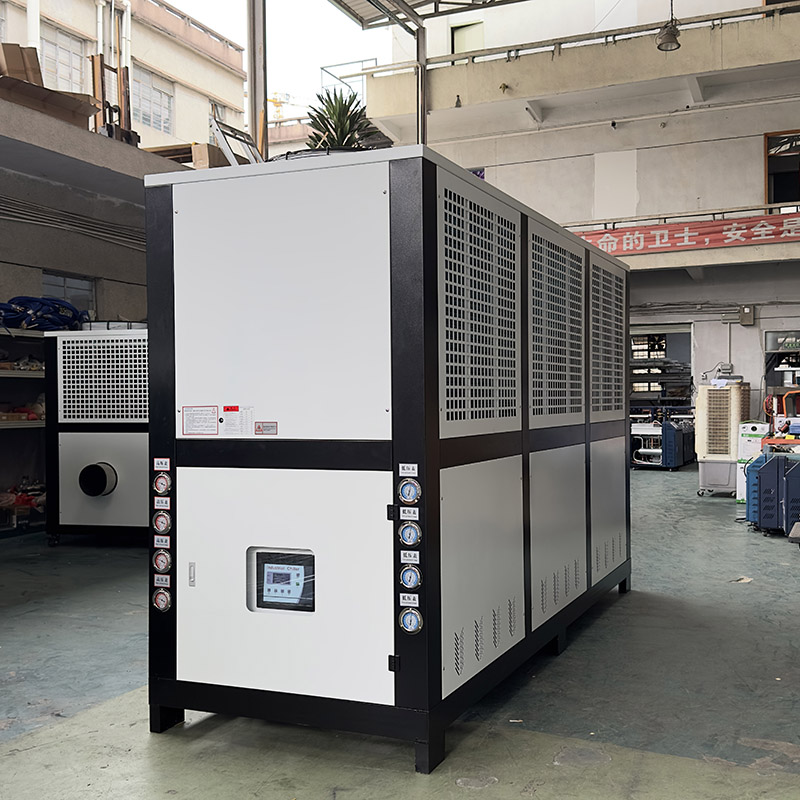
In the field of food production, temperature control is a key link determining product quality, safety, and shelf life. From raw material processing to finished product packaging, temperature fluctuations in any link may lead to food spoilage, decreased taste, or microbial growth, bringing huge economic losses to enterprises. The 50HP air-cooled chiller has become an ideal choice for many food production enterprises to achieve constant temperature production due to its stable refrigeration performance, precise temperature control ability, and energy-efficient advantages. As a high-power refrigeration equipment, the core advantage of the 50HP air-cooled chiller is its ability to provide continuous and stable cooling supply for large-area food production workshops. This equipment adopts advanced air-cooled condensation technology, which does not require a cooling water tower, is convenient and flexible to install, and is not limited by on-site water sources, making it particularly suitable for the complex layout environment of food production workshops. At the same time, the equipment is equipped with a high-precision temperature control system, with a temperature control accuracy of ±1℃, which can accurately meet the strict temperature requirements of different food production processes. It can easily handle both low-temperature refrigerated meat processing workshops and medium-temperature fresh-keeping fruit and vegetable processing workshops. ----------------------------- Food is highly sensitive to temperature during production. Taking baked food production as an example, the dough fermentation stage requires a stable temperature environment. Too high or too low temperature will affect the fermentation effect of the dough, leading to rough taste and poor shape of the finished product; in dairy production, if the temperature control is improper during the cooling link after sterilization, it is easy to breed harmful microorganisms and affect product safety. The 50HP air-cooled chiller can continuously maintain a constant temperature in the production workshop, effectively inhibit the growth and reproduction of microorganisms, ensure that food is in the best temperature state in each production link, guarantee food quality and safety from the source, and reduce the risk of product spoilage caused by temperature fluctuations. ----------------------------- Improve Production Efficiency, Reduce Operating Costs Traditional refrigeration equipment often has problems such as low refrigeration efficiency, high energy consumption, and high failure rate, which not only affect the production progress but also increase the operating costs of enterprises. The 50HP air-cooled chiller adopts an efficient compressor and an optimized heat exchange system, which greatly improves the refrigeration efficiency. It can quickly reach the set temperature and maintain stability, reducing the start-stop frequency of the eq...
Read More

Our company's series of products are well-known in the plastic auxiliary machinery industry for their excellent performance and high cost performance.


 IPv6 network supported


 English
  English
 español
 العربية