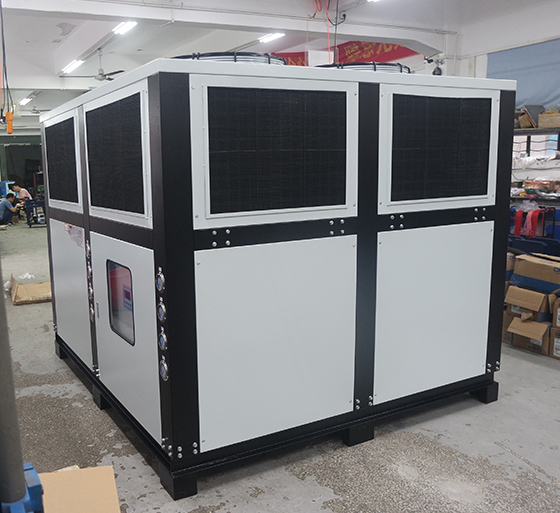
In industrial production, a fault in an industrial chiller is likely to cause production line shutdowns and economic losses. Mastering efficient fault diagnosis and resolution techniques helps enterprises quickly restore equipment operation and minimize the impact of downtime. Below, we start from common fault phenomena, sort out the diagnosis process and corresponding solutions, to provide protection for production. First, let’s look at the high-frequency fault of "insufficient cooling capacity". If you find that the chiller cannot meet the cooling requirements of production, first check whether the refrigerant is sufficient - this can be judged by observing the sight glass. If a large number of bubbles appear, it is likely that the refrigerant is leaking or insufficient. At this time, you need to first check for leak points, focusing on pipeline interfaces and valve seals. Apply soapy water to suspicious parts; if bubbles are generated, mark the leak points, repair them, and then refill with refrigerant of the appropriate type. If the refrigerant is sufficient, check whether the condenser is blocked: for air-cooled chillers, check if the condenser fins are dusty, and clean them with a high-pressure water gun (adjusted to low-pressure mode) or a special brush; for water-cooled chillers, check the quality of the cooling water. If excessive impurities in the water cause scaling in the condenser pipes, use a citric acid solution or professional descaling agent for cyclic cleaning to restore heat exchange efficiency. Second is the problem of "compressor failure to start". When this happens, first check the power supply: check if the circuit breaker in the distribution box has tripped. If it has tripped, confirm whether it is caused by overload, and try to reset it after the equipment cools down; at the same time, use a multimeter to measure the power supply voltage to ensure that the voltage is stable within ±5% of the equipment's rated voltage. Unstable voltage may trigger the compressor's protection mechanism. If the power supply is normal, check the thermostat and pressure relay: whether the set temperature of the thermostat is too high, causing the equipment to not need to start (you can appropriately lower the set value); if the pressure relay triggers protection due to excessively high high pressure or excessively low low pressure, you need to check the heat dissipation of the condenser (such as fan failure, insufficient cooling water flow) or refrigerant leakage respectively. After eliminating the problem, reset the pressure relay to start the compressor. Another fault is "excessive noise during equipment operation", which not only affects the working environment but may also hide the risk of component damage. First, check the compressor itself: if abnormal friction noise is heard during operation, the internal bearings of the compressor may be worn, and you need to shut down the equipment, disassemble it, an...
Read More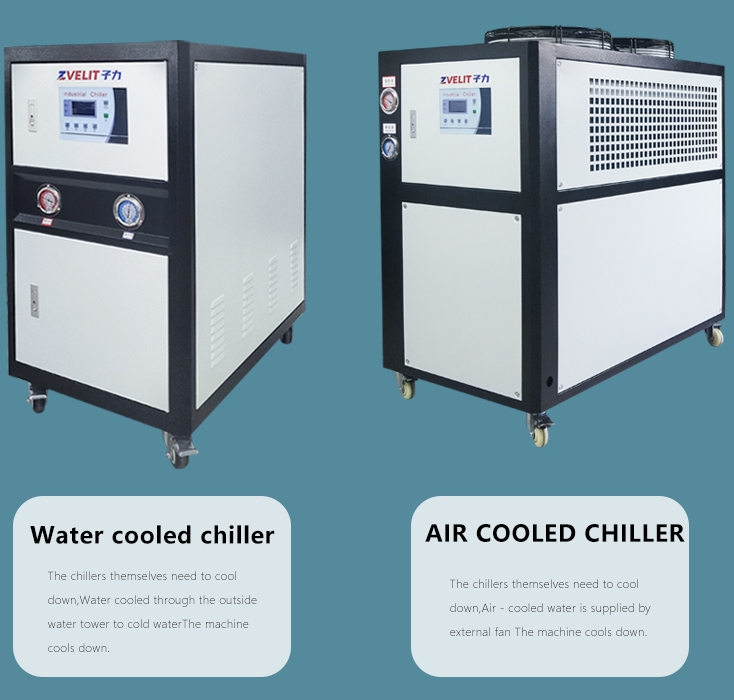
Both air cooled chillers and water cooled chillers are core industrial cooling systems, relying on the vapor compression cycle (as detailed in the earlier industrial chiller working principle guide) to remove heat. However, they differ significantly in heat dissipation methods, structure, performance, and application scenarios—critical factors for buyers to choose the right model. Below is a detailed comparison of their key differences. 1. Core Difference: Heat Dissipation Method (Condenser Operation) The fundamental distinction lies in how the condenser (a key component in the refrigeration cycle) releases heat to the external environment—this directly shapes the chiller’s design and usage conditions. Air Cooled Chiller Heat Dissipation Medium: Uses ambient air as the cooling medium. Condenser Design: Equipped with an air-cooled condenser (finned coils + fans). After the compressor outputs high-temperature refrigerant vapor, the vapor flows through the condenser coils; fans blow ambient air over the fins, transferring heat from the refrigerant to the air, which is then discharged to the atmosphere. No Additional Water System: Does not require a separate water supply or circulation system for cooling, simplifying installation. Water Cooled Chiller Heat Dissipation Medium: Uses water (usually from a cooling tower or tap water) as the cooling medium. Condenser Design: Features a water-cooled condenser (shell-and-tube or plate heat exchanger). High-temperature refrigerant vapor enters the condenser, and cooling water flows through the exchanger’s tubes; heat is transferred from the refrigerant to the water, which then carries the heat away (e.g., to a cooling tower, where the water is cooled and recycled). Depends on Auxiliary Water Systems: Requires matching equipment like cooling towers, water pumps, and pipelines to circulate and cool the water—adding complexity to the overall system. 2. Structural & Installation Differences Air Cooled Chiller Structure: More compact, integrating the condenser, fans, and main unit into one system. No need for additional water tanks, pumps, or cooling towers. Installation Requirements: Needs sufficient open space (e.g., rooftops, outdoor yards) to ensure unobstructed air flow—blocked air intake will reduce heat dissipation efficiency. Requires minimal pipeline work (only for process fluid circulation, not cooling water). Shorter installation time (typically 1-2 weeks for small-to-medium models). Water Cooled Chiller Structure: The main unit (compressor, evaporator, condenser) is separate from auxiliary equipment (cooling tower, water pump, water treatment system), leading to a more scattered layout. Installation Requirements: Needs space for both the chiller unit and auxiliary water systems (cooling towers are often installed on rooftops, while pumps may be in machine rooms). Requires complex pipeline installation (for cooling water circulation, includ...
Read More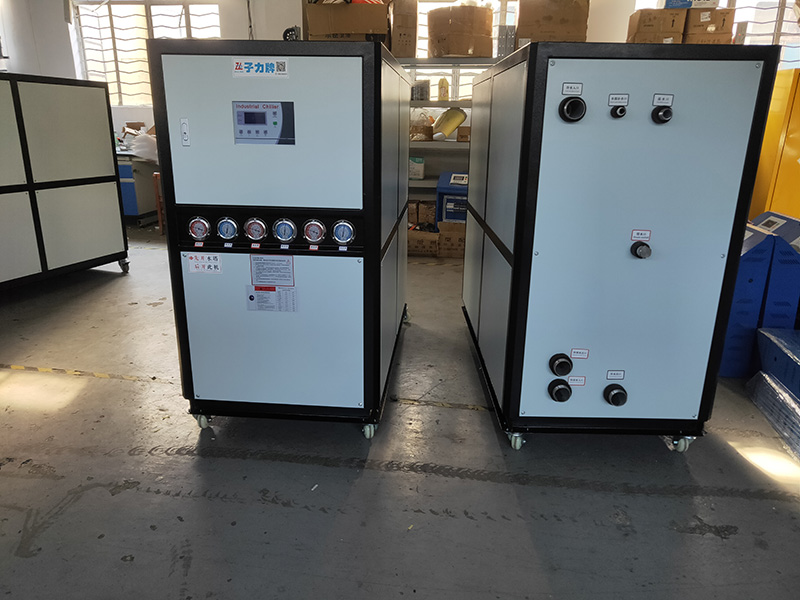
In modern industrial production and commercial applications, chillers, as key refrigeration equipment, are widely used in numerous industries such as pharmaceuticals, chemicals, electronics, food, and air conditioning systems. Air-cooled chillers and water-cooled chillers, as the two mainstream types in the chiller family, each play an important role in different application scenarios with their unique advantages and characteristics. Next, let's have an in-depth understanding of these two types of chillers. Air-cooled Chillers: Convenient and Flexible Refrigeration Pioneers Air-cooled chillers cool room-temperature water via a compressor to enhance cooling for molds or machines, comprising three key systems: refrigerant circulation (liquid refrigerant evaporates in the evaporator, is compressed, condenses in the condenser, and throttles back), water circulation (pump delivers water to equipment, which returns after absorbing heat), and electrical control (powers components and automates operation/protection). They feature easy installation (no cooling tower needed, compact and movable, ideal for water-scarce areas), stable performance (quality components, safety devices, low noise, long life, user-friendly interface), energy efficiency (some with multi-compressor systems adapting to loads), and strong adaptability (suitable for cooling various equipment like CNC machines and laser tools). However, they have lower COP (2.6-3.3), require good ventilation, and their cooling capacity drops in high-temperature workshops. Water-cooled Chillers: Efficient and Stable Refrigeration Mainstays Water-cooled industrial chillers, or water-cooled box-type units, use water as a heat exchange medium with a cooling tower. Their refrigerant circulation is similar to air-cooled ones, with cooling water dissipating heat via the tower. Structurally, they include a chilled water tank, pump, unit, cooling tower, and pipes, usable after connecting pipes and 380V power. They offer efficient refrigeration (higher energy efficiency by 300-500kcal/h than air-cooled due to water's properties), precise temperature control (5°C-35°C, suited for processes like plastic molding), stable operation (efficient heat exchangers, safety systems), and wide application (medical, food, chemical, etc.). But they need auxiliary equipment (larger footprint, complex installation), require good water quality to prevent scaling/blockages, and demand regular maintenance. In conclusion, air-cooled chillers and water-cooled chillers have their own advantages and disadvantages. In practical applications, users should comprehensively consider their specific needs, installation environment, operating costs and other factors to choose the most suitable type of chiller, so as to achieve efficient, stable and economical refrigeration effects. With the continuous progress and innovation of refrigeration technology, air-cooled chillers and water-cooled chillers will...
Read More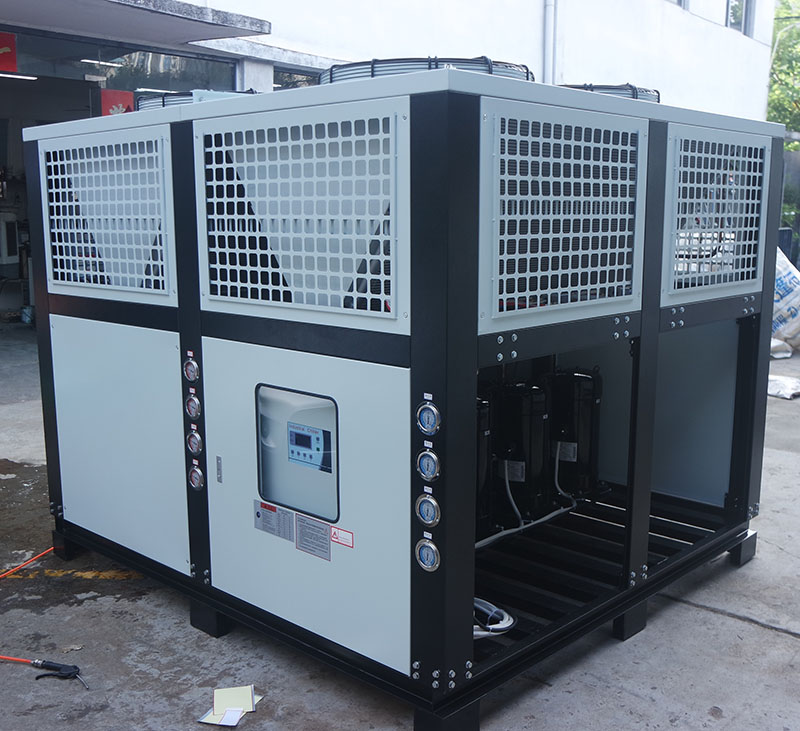
Industrial water chillers play a core role in air conditioning systems by providing a stable supply of low-temperature chilled water, supporting cooling for buildings or specific spaces. Here’s how they are applied and their underlying principles: I. Core Role in Air Conditioning Systems Industrial water chillers (such as scroll or screw types) generate low-temperature chilled water (typically 7–12°C) through a refrigeration cycle. This chilled water is pumped to terminal air conditioning equipment (e.g., fan coils, air handling units), where it exchanges heat with indoor air, absorbing heat to lower room temperatures and achieve cooling. ----------------------------- II. Integration with Air Conditioning Systems The integration of industrial water chillers with air conditioning systems is typically achieved through a "water system," following this process: Chilled Water Production: In the chiller’s evaporator, refrigerant absorbs heat from the water, lowering its temperature to a set value (e.g., 7°C). Chilled Water Circulation: The low-temperature water is pumped to terminal air conditioning equipment (fan coils, air handling units, etc.). Terminal Heat Exchange: At the terminals, chilled water absorbs heat from warm indoor air, cooling the air while the water itself warms to around 12°C. Return Water Recooling: The warmed water flows back to the chiller’s evaporator, where it is recooled by the refrigerant, completing the cycle. ----------------------------- III. Suitable Scenarios for Air Conditioning Industrial water chillers, valued for their high cooling capacity and stability, are ideal for medium-to-large air conditioning systems, including: Commercial Buildings: Office towers, shopping malls, hotels, etc., requiring centralized cooling for large spaces. Public Facilities: Hospitals, stadiums, airports, where reliable air conditioning operation is critical. Industrial Plants: Workshops needing both process cooling and employee comfort (e.g., electronics or precision instrument workshops). Large Data Centers: Maintaining a constant ambient temperature (typically 20–25°C) for equipment and staff, with chillers serving both cooling needs. IV. Advantages Over Traditional Air Conditioners High Cooling Capacity for Large Areas: A single industrial chiller can deliver tens to hundreds of refrigeration tons, covering spaces over 10,000 square meters without needing multiple small units. Higher Energy Efficiency, Lower Operating Costs: Equipped with high-efficiency compressors (scroll, screw) and heat exchangers, combined with inverter control, they achieve a higher COP (Coefficient of Performance) at partial loads than conventional air conditioners. Centralized Control for Easy Management: A central control system regulates cooling output, water temperature, and pump operation, adjusting dynamically to indoor loads to reduce energy waste. Flexible Installation fo...
Read More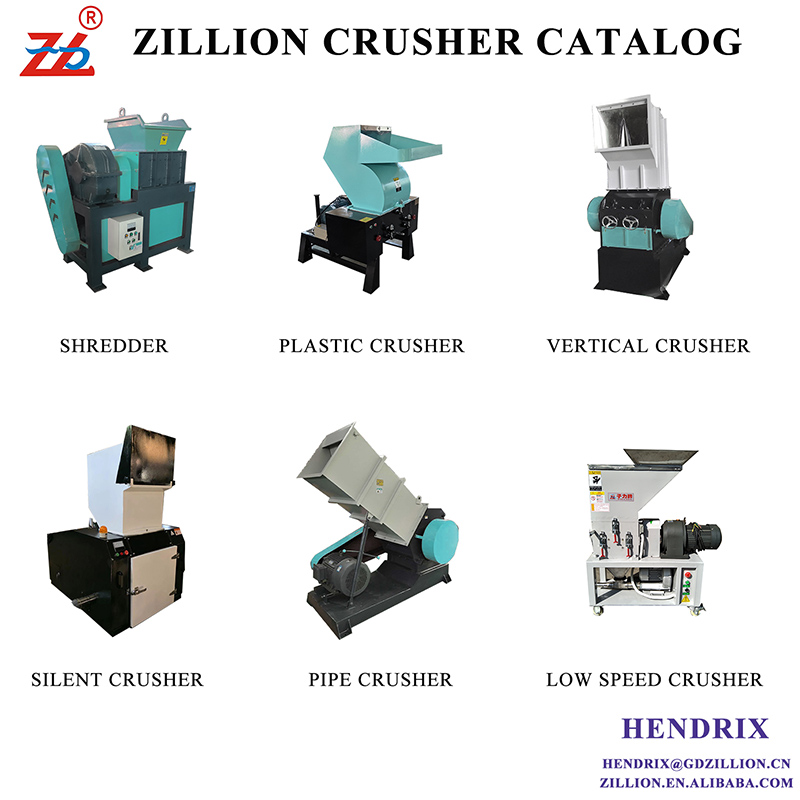
In the plastic recycling industry, the plastic shredder plays a pivotal role in breaking down plastic materials into smaller pieces for subsequent recycling processes. Making the right choice of a plastic shredder is crucial for ensuring efficient recycling operations. Here are some key aspects to consider when selecting a plastic shredder. Types of Plastic Shredders There are various types of plastic shredders designed for different plastics. For instance, the pet bottles shredder is specifically for processing PET bottles. The pp, pe, etc. plastic film crusher is suitable for plastic films made of polypropylene (PP) and polyethylene (PE). The hard plastic grinder is designed to handle hard plastic materials, and the styrofoam crushing machine is used for styrofoam. Based on the number of blade shafts, plastic shredders can be classified into single - shaft shredders, double - shaft shredders, and multi - shaft shredders. The multi - shaft shredder offers high output, making it ideal for large - scale production scenarios. In contrast, the single - shaft shredder is more flexible and is a good fit for manufacturers with lower output requirements. POWERFUL PLASTIC CRUSHER The powerful plastic shredder, with robust blades and high torque, efficiently crushes tough and thick plastic materials, ideal for heavy - duty recycling tasks. LOW NOISE SIDE SHREDDER The in - line slow shredder operates at a low speed, minimizing dust and noise, making it perfect for integrating with production lines to handle scrap plastics on - site. SHREDDER MACHINE The shredder, boasting strong cutting force, excels at breaking down thick plastics and metals into manageable pieces, serving as a reliable pre - processing tool. ----------------------------- Crushing Capacity The capacity of a plastic shredding machine is influenced by several factors. One of them is the inner chamber size. The size of the crusher is determined by the inner chamber. Generally, the width of the crusher's inner chamber ranges from 80 to 150 cm. A wider crusher usually means higher output. The speed of the crusher pulley also affects the capacity. The speed of the pulley on the crusher is calculated by multiplying the motor speed by the diameter of the small pulley next to it and then dividing by the diameter of the pulley on the crusher. Within the reasonable range of 400 to 800 rpm, a higher speed generally leads to higher output. However, if the speed is too low, the machine may jam, and if it is too high, the machine may vibrate. The design of screens and blades is another crucial factor. The size of the crushed material is controlled by the mesh size of the screen. For example, the mesh size of pet bottle flakes is usually adjusted to 16 - 18 mm, while that of pvc plastic steel is around 30 mm. Thicker blade thickness and a smaller gap between the blades are beneficial. For example, some efficient shredder blades are about 10 - 30 mm thick, and the gap is usually between 0.2 and 1 mm...
Read More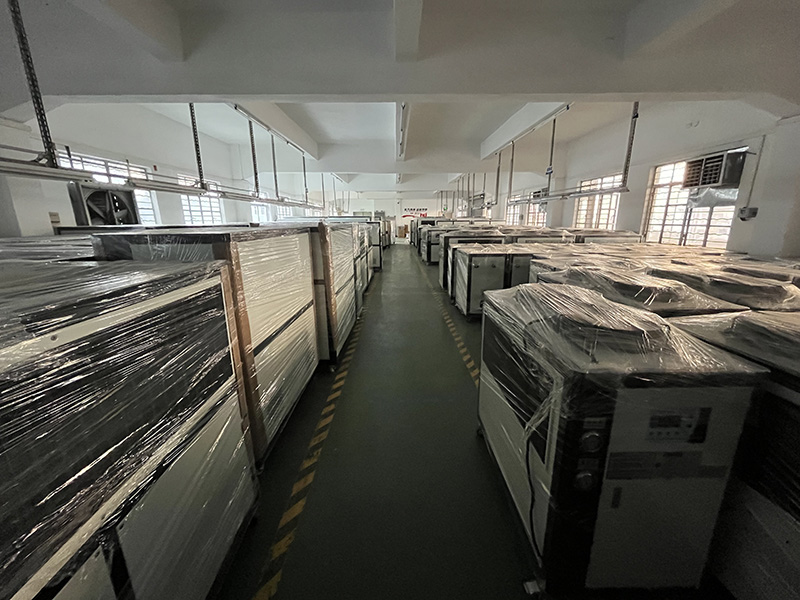
As China prepares to celebrate the May Day holiday (May 1-5, 2025), DongGuan Zillion Mechanical & Electrical Equipment Co., Ltd. announces its commitment to maintaining full service for international clients. While many businesses pause operations, our factory and export team will remain available to ensure seamless communication and support for industrial equipment inquiries, quotes, and orders. Why Choose Zillion During Holidays? ✅ 12+ Years Export Expertise: Specializing in plastic processing machines (crushers, dryers, loaders) and industrial refrigeration equipment (chillers, mold temperature controllers, cooling towers), we serve 50+ countries year-round.✅ Factory-Direct Efficiency: Skip trading company markups – enjoy 30% lower prices and fast turnaround (7-15 days for standard orders, FOB Shenzhen).✅ 24/7 Support: Our sales and technical teams are on standby via WhatsApp (+86 15602232700) and email (hendrix@gdzillion.com) to address urgent needs. Stay Productive with Zillion’s Solutions Whether you’re optimizing a Vietnam injection molding factory with our precision chillers or enhancing a Brazilian recycling plant with high-speed crushers, our equipment boosts efficiency and reduces downtime. Visit our website (www.zillionchiller.com) to explore case studies of clients who improved product yield by 15% and waste processing speed by 50%. Don’t let holidays slow your production! Contact us today for a free quote or personalized solution.
Read More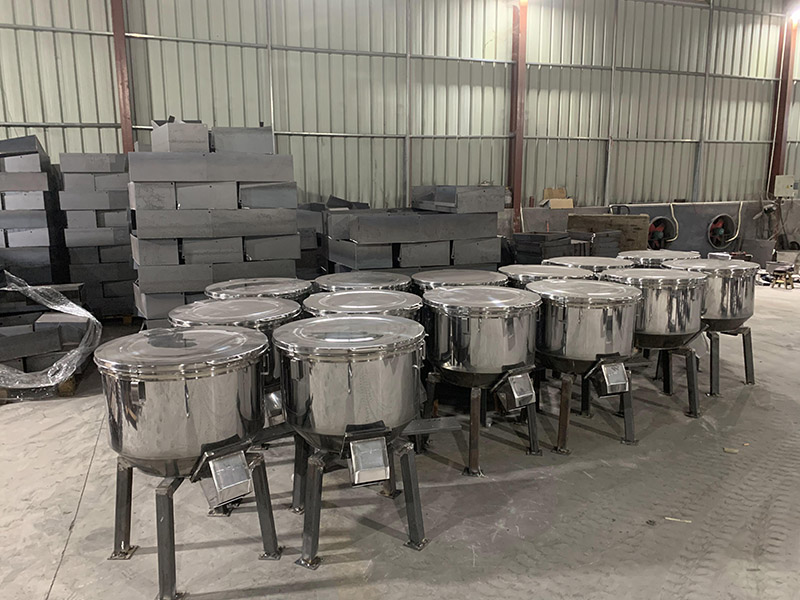
The year 2024 has been a year full of opportunities and challenges for the field of plastic mixers. Many innovative patent technology achievements have emerged, injecting strong impetus into the development of the entire industry. A patent technology for a new type of plastic pellet mixer has attracted a lot of attention. Its uniqueness lies in the discharge components installed on both sides of the mixing tank, allowing plastic pellets to be dried directly during the falling process. At the same time, the isolation plate is used to effectively prevent the adhesion between pellets, greatly improving the mixing effect and production efficiency and providing a more convenient and efficient solution for the processing of plastic pellets. Meanwhile, a high mixer patent for plastic pellet processing has also received much acclaim. The driving motor drives the connecting rod, which in turn drives the stirring rod and paddle to mix and stir the plastic. Equipped with an electric lifting rod, it can easily drive the mixing paddle to rise and fall, facilitating the turning of the plastic at the bottom of the mixing barrel and ensuring the uniformity of the plastic pellet mixing, effectively enhancing the product quality. In addition, a patent technology for an easy-to-clean mixer has solved the long-standing cleaning problem in the industry. By installing an arc frame and wire bristles on the stirring rod, the inner wall of the mixing drum can be automatically cleaned during the mixing process, avoiding residual impurities on the inner wall of the mixing drum after mixing, significantly improving the practicability and cleaning efficiency of the device and reducing the equipment maintenance cost of enterprises. A patent for an automatic drying and blending device for plastic pellets has also brought new vitality to the industry. Through the coordinated operation of components such as the mixing barrel, motor, electric slide table, stirring rod, heating tank, and heating wire, automatic drying and blending of plastic pellets are realized, not only improving work efficiency but also facilitating the removal of materials, providing a more intelligent and efficient equipment option for the processing of plastic pellets. These patent achievements fully demonstrate the innovation vitality and development potential of the plastic mixer industry. They not only create competitive advantages for enterprises but also contribute to the technological progress and sustainable development of the entire industry. On the future development path, we look forward to seeing more innovative achievements emerge, driving the plastic mixer industry to continue to move towards a higher level and providing a strong guarantee for the prosperous development of the plastics industry.
Read More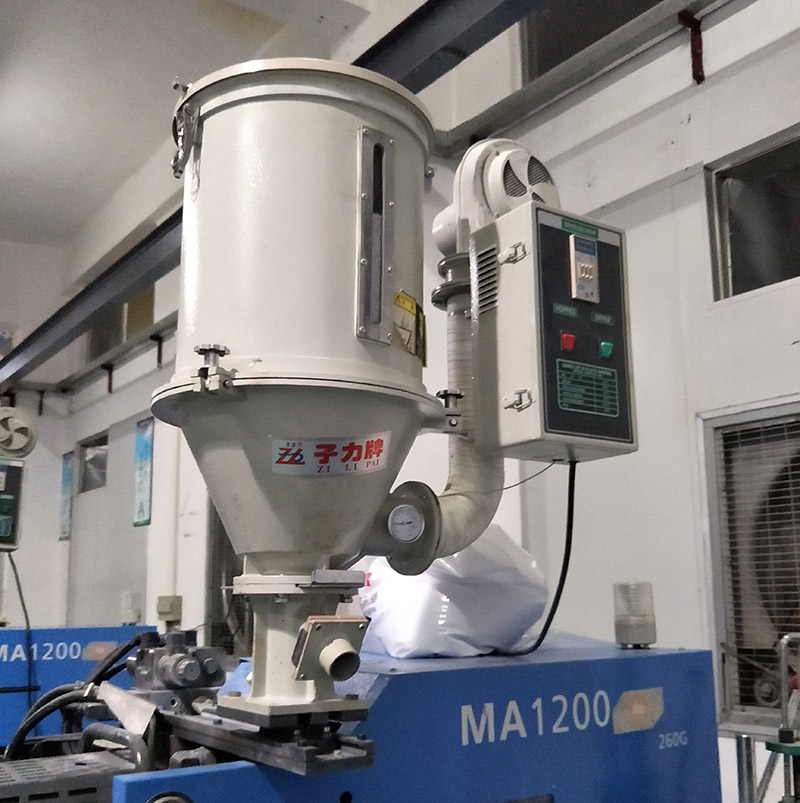
When it comes to plastic processing, one cannot overlook the significance of proper drying. The Hopper Dryer, Hopper Dryer Heater, and Plastic Drying Machine are the heroes behind ensuring high-quality plastic products. The Hopper Dryer serves as the core equipment for drying plastic resins. It creates an environment where moisture is effectively eliminated. The Hopper Dryer Heater, a key element within, generates the heat required for this moisture removal process. By precisely controlling the temperature, it enables the plastic granules to be dried to the ideal moisture level. This is crucial as any residual moisture can cause molding problems, such as inconsistent part dimensions and weakened product integrity. A Plastic Drying Machine, especially the Hopper Dryer variety, offers versatility. It can handle different types and quantities of plastic materials. The adjustable temperature and drying time settings make it adaptable to various production demands. Whether it's a small-scale operation or a large industrial setup, these machines can be configured to optimize the drying process. Zillion's Plastic Drying Machine, including the Hopper Dryer and Hopper Dryer Heater, has distinct advantages. The product is engineered with state-of-the-art technology, providing accurate temperature control within a narrow margin. This precision leads to more consistent drying results and better quality plastic products. Moreover, Zillion is renowned for its customer-centric service. Their technicians are available round the clock to offer technical advice and troubleshooting. They also provide regular maintenance schedules to keep the machines in peak condition. With Zillion's Plastic Drying Machine, you are investing in a reliable solution that combines top-notch product quality and outstanding service support, ensuring your plastic processing operations run smoothly and efficiently.
Read More

Our company's series of products are well-known in the plastic auxiliary machinery industry for their excellent performance and high cost performance.


 IPv6 network supported


 English
  English
 español
 العربية