ZL-80T 80 Ton Industrial FRP Counter Flow Cooling Tower - Engineering Specifications
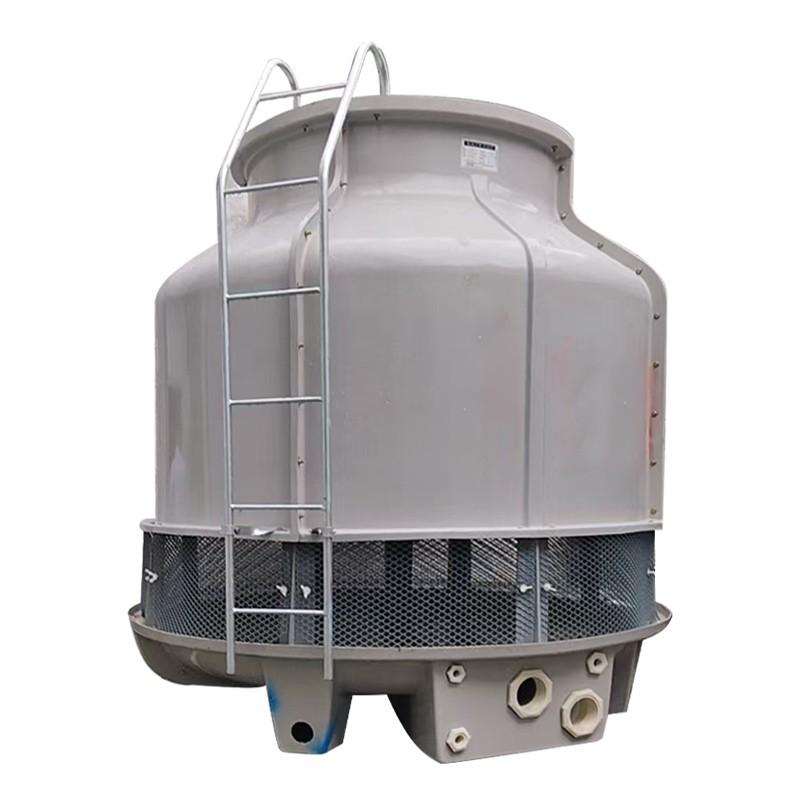
The ZL-80T FRP counter flow cooling tower delivers 281.29 kW heat rejection at 80 refrigeration tons with 62.6 m3/h water flow rate. The following sections detail engineering specifications, operational considerations, and application-specific integration guidance for the ZL-80T.
The 80-ton ZL-80T is rated at 281.29 kW of heat rejection under CTI STD-201 design conditions (95 deg F inlet water, 85 deg F wet-bulb, 5 deg F range). The flow rate of 62.6 m3/h is calibrated to a 5 deg C temperature drop across the fill media, which is the standard range for induced-draft counter-flow cooling towers. At this flow rate, the ZL-80T delivers exactly 281.29 kW of heat rejection when the leaving water temperature reaches 32 deg C against a 27 deg C wet-bulb. For applications requiring higher temperature drops (8-10 deg C), the tower can accept lower flow rates while maintaining the same 281.29 kW heat duty. This makes the ZL-80T suitable for industrial facilities, 800-1200 ton injection molding, hyperscale data centers where standard HVAC loop conditions apply.
The wet-bulb approach is the most critical performance metric for any cooling tower. The ZL-80T achieves a 5 deg C approach under standard design (27 deg C WB), meaning the leaving water reaches 32 deg C. As ambient conditions deviate from design, the approach varies predictably: at WB 24 deg C the leaving water drops to 29 deg C; at WB 30 deg C the leaving water climbs to 35 deg C; at WB 21 deg C the leaving water drops to 26 deg C. The ZL-80T's 450 CMM airflow at 1180 mm fan diameter is specifically sized to maintain this 5 deg C approach across the expected operating range. Off-design performance is documented in CTI thermal performance curves and is reproducible year-over-year when water flow and chemistry remain within design limits.
The ZL-80T uses counter-flow geometry where water falls downward through the fill media while air rises upward through the same media. This counter-flow arrangement provides 15-20 percent better thermal performance than cross-flow designs at the same airflow rate. The tower diameter of 2100mm and height of 2320mm are optimized for the 62.6 m3/h water flow rate. PVC film fill media is standard for low-fouling operation, with cellular drift eliminators reducing drift loss to 0.005 percent of circulating flow.
The ZL-80T's axial fan delivers 450 CMM of airflow at design conditions, driven by a 1.5 kW motor at 380V 3-phase 50 Hz. The 1180mm propeller diameter is sized to move 450 CMM against the 18 kPa external static pressure of the fill media and drift eliminators. Fan tip speed is kept below 60 m/s to minimize noise (the ZL-80T operates at 65-70 dB(A) at 5 meters) and to extend bearing life beyond 50,000 hours. Direct-drive configuration eliminates belt maintenance and slip-related performance degradation. For variable-speed applications, a VFD can reduce airflow to 50 percent of design during cool-weather operation.
The ZL-80T's 18 kPa head loss at design flow (62.6 m3/h) is the external static pressure that the chilled water pump must overcome, in addition to the chiller evaporator and piping losses. For a typical HVAC installation with 80 meters of equivalent piping and a chiller with 50 kPa evaporator pressure drop, total system head requirement is approximately 130 kPa. The ZL-80T's 18 kPa contribution is significant, requiring careful pump selection. Variable-speed pump operation can save 30-50 percent pumping energy by throttling flow during low-load periods.
The ZL-80T shell is constructed from fiberglass-reinforced polyester (FRP) with UV-stabilized gelcoat surface, providing 15-20 year service life in outdoor environments. Dry weight of 260 kg and operating weight of 1280 kg require a flat concrete pad capable of supporting 1380 kg per square meter. The ABS fan is corrosion-resistant and balanced to ISO 1940 G6.3 standard. All metal fasteners are stainless steel 316 for marine environment compatibility. Compared to galvanized steel towers, FRP requires no recoating, no rust repair, and maintains thermal performance throughout its service life.
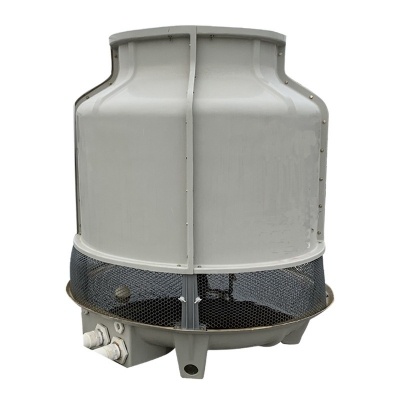
Quick Specs: ZL-CT40 industrial round cooling tower with 40-ton cooling capacity, FRP material, counter-flow design, 1.5kW fan, CE certified. Best for industrial chiller systems and mid-scale manufacturing. The water cooling tower is a device used for cooling circulating water. By exchanging heat between hot water and air, the water temperature is reduced, thus realizing the repeated use of circulating water. Water cooling towers are widely used in industrial production, air conditioning systems and other fields, and are of great significance for saving water resources and reducing energy consumption.
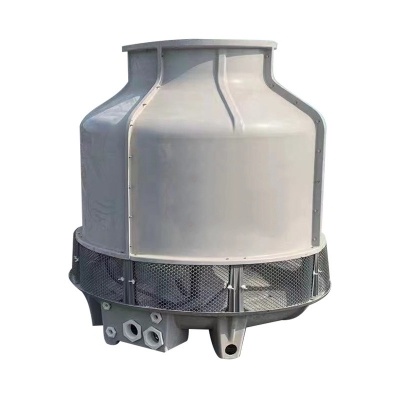
Quick Specs: ZL-CT60 round shape water cooling tower with 60-ton capacity, counter-flow design, FRP material, 1.5kW fan, CE certified. Best for industrial chiller systems and large-scale cooling. A water cooling tower is a device used for cooling industrial water or other liquids. Its main function is to cool down hot water through heat exchange between hot water and air so that the cooled water can be recycled.
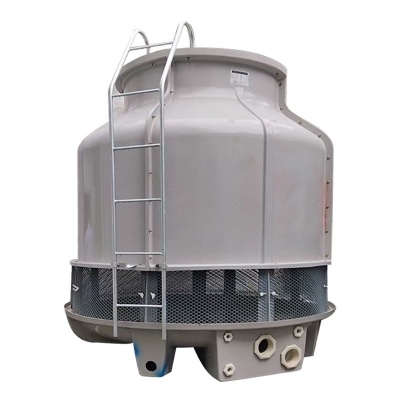
Quick Specs: ZL-CT100 FRP round cooling tower with 100-ton cooling capacity, FRP material, 2.2kW fan, CE certified. Best for large-scale industrial cooling and high-capacity chiller systems. The counterflow cooling tower is a common type of cooling tower. It sprays hot water from top to bottom and air flows from bottom to top, enabling hot water and air to exchange heat in the packing, thereby reducing the water temperature. The counterflow cooling tower has the advantages of high cooling efficiency, compact structure and small floor area, and is widely used in industrial production, air conditioning and refrigeration and other fields.
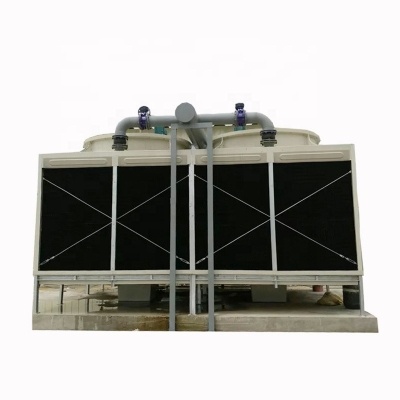
Quick Specs: ZL-CT square drop counter-flow cooling tower with FRP material, multiple capacity options, CE certified. Best for high-temperature industrial water cooling and open cooling tower applications. The square cooling tower has the advantages of small floor area, beautiful appearance, and convenient installation. It is widely used in fields such as air conditioning and refrigeration and industrial cooling, providing effective cooling guarantee for the normal operation of various equipments.
Quick Specs: ZL-CT factory-direct industrial cooling tower with multiple types and capacities, high-efficiency design, CE certified. Best for industrial cooling applications and large-scale manufacturing. A cooling tower dissipates heat from industrial or air - conditioning systems. Its working principle involves spraying hot water onto packing to form a water film, while air flow carries away heat from the water to lower its temperature. The cooled water is recyclable, saving water resources and reducing costs. There are various types, such as open and closed cooling towers. Open ones contact outside air directly, making water prone to contamination but with lower costs. Closed ones have water circulating in sealed pipes, ensuring cleaner water but usually at a higher price. Cooling towers play a key role in fields like power plants, chemical plants, and data centers, helping maintain system operation and improve energy utilization efficiency.
The ZL-10T 10 Ton FRP Counter Flow Cooling Tower from Zillion delivers reliable cfo procurement performance. Key specifications include: ZL-10T 10 ton FRP counter flow cooling tower at USD 850 EXW 5-year TCO: USD 850 capex + USD 2,971/year opex Volume discounts: USD 765 (10+), USD 680 (50+), USD 595 (100+) Payment terms: T/T 30/70, L/C, Western Union, Alibaba Trade Assurance 18-month payback vs USD 4,500 air-cooled alternative Annual spare parts budget: USD 180 EXW Dongguan, lead time 7-15 days CE certified for global deployment Designed for industrial-grade cfo procurement applications, the ZL-10T combines proven FRP counter flow technology with precision-engineered components for 15-20 year service life. CE / ISO 9001:2015 certified. Contact Leika at Leika@gdzillion.cn for quotation.
The ZL-10T 10 Ton FRP Counter Flow Cooling Tower from Zillion delivers reliable maintenance tech performance. Key specifications include: ZL-10T water chemistry: pH 6.5-9.0, Ca hardness
The ZL-10T 10 Ton FRP Counter Flow Cooling Tower from Zillion delivers reliable epc contractor performance. Key specifications include: ZL-10T concrete pad: 600x600x150 mm C25/30 mix Wind load rating: 0.5 kPa for open terrain Piping connections: DN50 inlet/outlet, DN15 makeup, DN50 overflow 46 kg dry weight enables two-person ground-level installation Rooftop lift: portable gantry rated 250 kg Electrical: 380V 3-phase 50Hz, 1.2-1.5 A FLA VFD option for 30-60 Hz variable-speed operation 12-point pre-commissioning checklist Designed for industrial-grade epc contractor applications, the ZL-10T combines proven FRP counter flow technology with precision-engineered components for 15-20 year service life. CE / ISO 9001:2015 certified. Contact Leika at Leika@gdzillion.cn for quotation.


Our company's series of products are well-known in the plastic auxiliary machinery industry for their excellent performance and high cost performance.


 IPv6 network supported


 English
  English
 español
 العربية