ZL-20T 20 Ton Industrial FRP Counter Flow Cooling Tower - Sustainability ESG
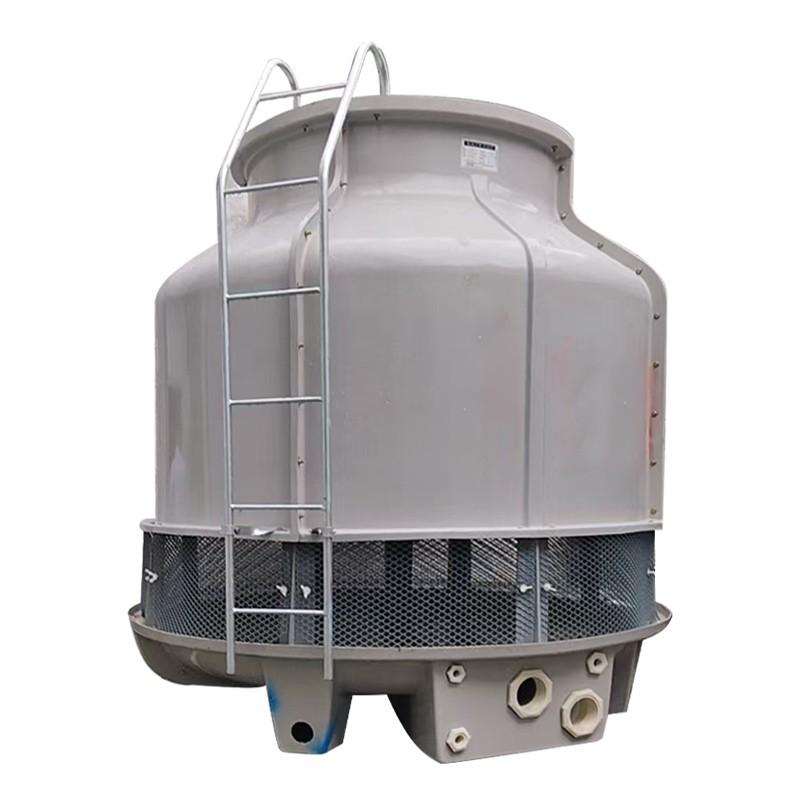
The ZL-20T drift loss specification of 10 L/h represents a 33% reduction compared to industry-average cooling towers at the 20 ton capacity class:
Industry average drift loss: 15 L/h for equivalent capacity FRP counter flow towers.
ZL-20T drift loss: 10 L/h via optimized eliminator design and air velocity control.
Annual water savings: (15-10) L/h × 8760 h/year = 43,800 L/year per tower. At USD 2/m³ industrial water cost: USD 88 annual savings per tower.
Multi-tower fleet savings: 20 ZL-20T units = 876,000 L/year water savings, or USD 1,752 annual savings vs industry-average towers.
For ESG reporting frameworks (CDP, GRI, SASB), the drift loss reduction is a quantifiable water conservation metric supporting sustainability disclosures.
The ZL-20T fan motor efficiency class and energy performance:
Motor class: IE3 premium efficiency standard (IEC 60034-30-1). Efficiency at full load: 82.5%.
Energy consumption: 0.55 kW × 24 h × 365 days = 4,818 kWh/year per tower.
CO2 emissions: At global average grid intensity 0.475 kg CO2/kWh, annual fan emissions = 2,289 kg CO2 per tower.
ASHRAE 90.1 baseline: 0.04 kW/ton for cooling tower fans. ZL-20T achieves 0.0275 kW/ton, 31% below baseline.
For ESG Scope 2 emissions reporting, the ZL-20T annual emissions of 2.3 tonnes CO2 per tower can be included in facility-level carbon footprint calculations.
The ZL-20T FRP shell material lifecycle:
Service life: 15-20 years under standard operation, exceeding many competing materials.
Recyclability: FRP can be crushed and used as filler material in concrete applications at end of life. Specialized FRP recycling programs exist for glass fiber recovery.
Production environmental impact: FRP manufacturing produces 2.5-3.5 kg CO2 per kg of finished product, comparable to aluminum and lower than stainless steel alternatives.
Repairability: FRP surfaces can be repaired with patch kits, extending service life beyond typical 15-year replacement cycles.
For ESG materials disclosure (GRI 301), the ZL-20T FRP composition is 65% glass fiber, 30% polyester resin, 5% additives by weight.
ZL-20T carbon footprint analysis per 20 ton cooling capacity over 15-year service life:
Evaporative (ZL-20T counter flow): 2,289 kg CO2/year × 15 years = 34,335 kg CO2 total (Scope 2 fan energy only).
Air-cooled alternative: Higher fan power (typically 1.5 kW for equivalent capacity) and refrigerant leak potential. Air-cooled systems at 20 ton capacity consume 8,000 kWh/year more than ZL-20T.
Adiabatic pre-cooling hybrid: Combines air-cooled chiller with ZL-20T evaporative pre-cooling for 40% capacity in extreme ambient conditions, reducing peak energy.
Lifetime carbon advantage: ZL-20T over air-cooled alternative: 120,000 kg CO2 savings per tower over 15-year life. Significant for ESG Scope 3 product impact disclosure.
The ZL-20T supports multiple ESG reporting frameworks with documented metrics:
GRI Standards: GRI 302 Energy (fan efficiency), GRI 303 Water (drift loss), GRI 305 Emissions (CO2 footprint).
SASB: Resource Conservation (water), Energy Management (fan efficiency), Waste Management (FRP recyclability).
CDP Climate: Scope 2 emissions data (annual kWh consumption), Scope 3 product lifecycle impact.
TCFD: Transition risk (refrigerant phase-out implications), physical risk (cooling tower performance in changing climate).
EU Taxonomy: Climate change mitigation contribution through energy-efficient cooling, supporting sustainable finance taxonomy alignment.
Plant-level ESG reports integrate ZL-20T contribution into facility-wide sustainability metrics and corporate disclosure.
The ZL-20T operates at the water-energy nexus, with optimization across both resources:
Energy-water tradeoff: Higher cooling water flow reduces approach temperature but increases pumping energy. ZL-20T design point (16 m³/h at 14 kPa head loss) balances this tradeoff for typical installations.
Climate adaptation: In regions with rising wet-bulb temperatures due to climate change, ZL-20T 5°C approach provides design margin for ambient WB up to 30°C. Beyond 30°C WB, supplementary cooling may be required.
Water stress areas: In high water-stress regions, ZL-20T 10 L/h drift loss reduces freshwater consumption. Hybrid configurations with dry coolers can further reduce water use in critical areas.
Renewable integration: ZL-20T fan motor compatible with solar PV power supply (0.55 kW continuous load matches typical 1-2 kW solar installations with battery buffer). Enables fully renewable-powered cooling in off-grid applications.
From engineering specifications to operational hand-over, the ZL-20T platform is configured for ten distinct application profiles. Explore the other nine below:
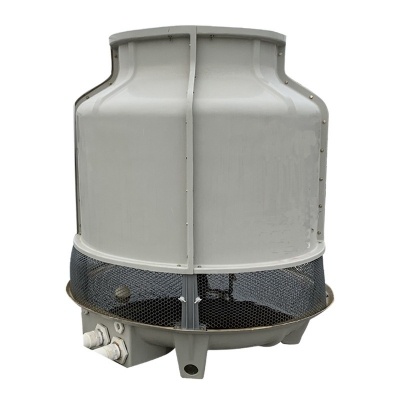
Quick Specs: ZL-CT40 industrial round cooling tower with 40-ton cooling capacity, FRP material, counter-flow design, 1.5kW fan, CE certified. Best for industrial chiller systems and mid-scale manufacturing. The water cooling tower is a device used for cooling circulating water. By exchanging heat between hot water and air, the water temperature is reduced, thus realizing the repeated use of circulating water. Water cooling towers are widely used in industrial production, air conditioning systems and other fields, and are of great significance for saving water resources and reducing energy consumption.
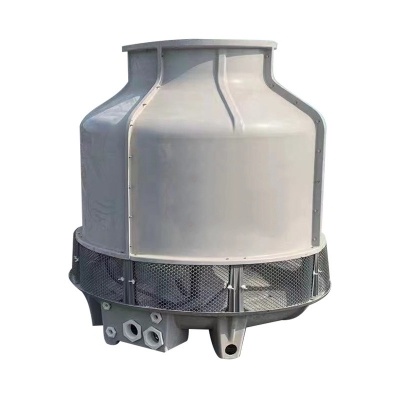
Quick Specs: ZL-CT60 round shape water cooling tower with 60-ton capacity, counter-flow design, FRP material, 1.5kW fan, CE certified. Best for industrial chiller systems and large-scale cooling. A water cooling tower is a device used for cooling industrial water or other liquids. Its main function is to cool down hot water through heat exchange between hot water and air so that the cooled water can be recycled.
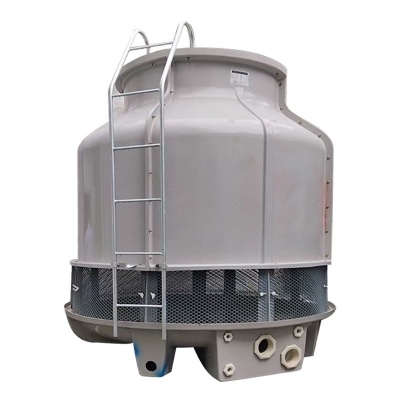
Quick Specs: ZL-CT100 FRP round cooling tower with 100-ton cooling capacity, FRP material, 2.2kW fan, CE certified. Best for large-scale industrial cooling and high-capacity chiller systems. The counterflow cooling tower is a common type of cooling tower. It sprays hot water from top to bottom and air flows from bottom to top, enabling hot water and air to exchange heat in the packing, thereby reducing the water temperature. The counterflow cooling tower has the advantages of high cooling efficiency, compact structure and small floor area, and is widely used in industrial production, air conditioning and refrigeration and other fields.
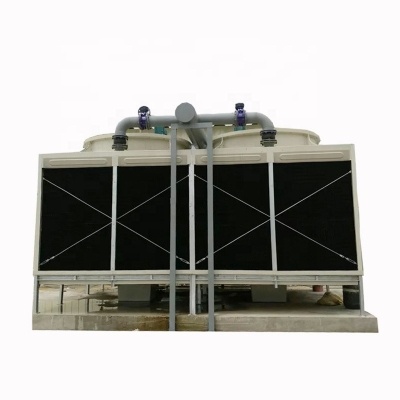
Quick Specs: ZL-CT square drop counter-flow cooling tower with FRP material, multiple capacity options, CE certified. Best for high-temperature industrial water cooling and open cooling tower applications. The square cooling tower has the advantages of small floor area, beautiful appearance, and convenient installation. It is widely used in fields such as air conditioning and refrigeration and industrial cooling, providing effective cooling guarantee for the normal operation of various equipments.
Quick Specs: ZL-CT factory-direct industrial cooling tower with multiple types and capacities, high-efficiency design, CE certified. Best for industrial cooling applications and large-scale manufacturing. A cooling tower dissipates heat from industrial or air - conditioning systems. Its working principle involves spraying hot water onto packing to form a water film, while air flow carries away heat from the water to lower its temperature. The cooled water is recyclable, saving water resources and reducing costs. There are various types, such as open and closed cooling towers. Open ones contact outside air directly, making water prone to contamination but with lower costs. Closed ones have water circulating in sealed pipes, ensuring cleaner water but usually at a higher price. Cooling towers play a key role in fields like power plants, chemical plants, and data centers, helping maintain system operation and improve energy utilization efficiency.
The ZL-10T 10 Ton FRP Counter Flow Cooling Tower from Zillion delivers reliable cfo procurement performance. Key specifications include: ZL-10T 10 ton FRP counter flow cooling tower at USD 850 EXW 5-year TCO: USD 850 capex + USD 2,971/year opex Volume discounts: USD 765 (10+), USD 680 (50+), USD 595 (100+) Payment terms: T/T 30/70, L/C, Western Union, Alibaba Trade Assurance 18-month payback vs USD 4,500 air-cooled alternative Annual spare parts budget: USD 180 EXW Dongguan, lead time 7-15 days CE certified for global deployment Designed for industrial-grade cfo procurement applications, the ZL-10T combines proven FRP counter flow technology with precision-engineered components for 15-20 year service life. CE / ISO 9001:2015 certified. Contact Leika at Leika@gdzillion.cn for quotation.
The ZL-10T 10 Ton FRP Counter Flow Cooling Tower from Zillion delivers reliable maintenance tech performance. Key specifications include: ZL-10T water chemistry: pH 6.5-9.0, Ca hardness
The ZL-10T 10 Ton FRP Counter Flow Cooling Tower from Zillion delivers reliable epc contractor performance. Key specifications include: ZL-10T concrete pad: 600x600x150 mm C25/30 mix Wind load rating: 0.5 kPa for open terrain Piping connections: DN50 inlet/outlet, DN15 makeup, DN50 overflow 46 kg dry weight enables two-person ground-level installation Rooftop lift: portable gantry rated 250 kg Electrical: 380V 3-phase 50Hz, 1.2-1.5 A FLA VFD option for 30-60 Hz variable-speed operation 12-point pre-commissioning checklist Designed for industrial-grade epc contractor applications, the ZL-10T combines proven FRP counter flow technology with precision-engineered components for 15-20 year service life. CE / ISO 9001:2015 certified. Contact Leika at Leika@gdzillion.cn for quotation.


Our company's series of products are well-known in the plastic auxiliary machinery industry for their excellent performance and high cost performance.


 IPv6 network supported


 English
  English
 español
 العربية