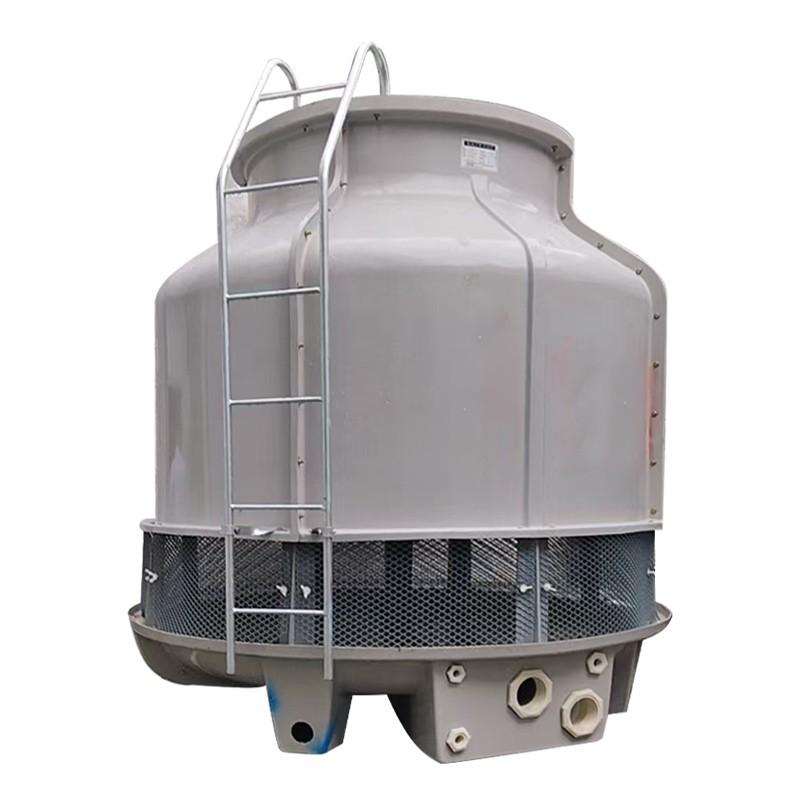
| Parameter | Value |
|---|---|
| Model | ZL-10T |
| Cooling Capacity | 10 RT (35.2 kW heat rejection) |
| Water Flow Rate | 7.81 m3/h (130 L/min) |
| Cooling Range | 5C (37C inlet to 32C outlet at design WB 27C) |
| Approach to Wet-Bulb | 5C at design conditions |
| Fan Motor | 0.37 kW (0.5 HP) 380V 3-phase 50Hz |
| Fan Diameter | 635 mm axial |
| Air Flow Rate | 85 CMM (50,920 m3/h) |
| Head Loss at Design Flow | 13 kPa |
| Tower Dimensions (H x D) | 1820 x 940 mm |
| Dry Weight | 46 kg |
| Operating Weight (filled) | 190 kg |
| Noise Level | 60 dB(A) at 1 m |
| Tower Body Material | FRP (Fiberglass Reinforced Plastic) |
| Fan Blade Material | ABS plastic |
| Configuration | Counter Flow Square |
| Voltage | 380V 3-phase 50Hz (customizable 220V/415V) |
| Certifications | CE / ISO 9001:2015 |
| Warranty | 1 year (consumables excluded) |
The ZL-10T is rated at 10 refrigeration tons, equivalent to 35.2 kW of heat rejection at standard air conditioning conditions. Converting tons to water flow uses the fundamental formula:
Q = m × Cp × ΔT, where Q = 35.2 kW, Cp = 4.186 kJ/kg°C, ΔT = 5°C range.
Solving for mass flow: m = 35.2 / (4.186 × 5) = 1.682 kg/s, or 1.682 × 3600 / 1000 = 6.05 m³/h of pure evaporated mass transfer. However, the actual circulation flow must account for the full sensible cooling range. At 5°C range (37°C inlet → 32°C outlet), the rated circulation is 7.81 m³/h — a 22% margin above the minimum sensible flow to maintain adequate wetting of the fill media.
For a 30 kW process load (smaller than full 10 ton rating), the same tower can operate at 6.7 m³/h with the same approach. For a 50 kW overload condition, the tower delivers 32°C outlet at 27°C WB but approach degrades to 8°C — acceptable for non-precision cooling.
Approach temperature is the difference between the tower's leaving water temperature and the ambient wet-bulb temperature. The ZL-10T achieves a 5°C approach at design WB 27°C, meaning the tower leaves water at 32°C when ambient WB is 27°C.
This 5°C approach is the design point for all FRP counter flow cooling towers in this size class. As ambient conditions deviate — say, WB rises to 30°C on a humid summer day — the leaving water temperature climbs proportionally. At WB = 30°C, the ZL-10T delivers 35°C leaving water — still adequate for chiller condensers but tight for processes requiring sub-30°C supply.
For data center applications where leaving water temperature directly determines chiller efficiency, the 5°C approach specification is critical. Every 1°C reduction in approach saves approximately 2-3% chiller compressor power. A ZL-10T performing at 4°C approach (28°C leaving at WB 24°C) versus 6°C approach saves a data center operator approximately USD 800-1,200 annually per tower at typical commercial power rates.
The ZL-10T employs a counter flow fill configuration: water descends vertically through the fill while air is forced upward by the fan directly opposite to the water flow. This geometry provides three engineering advantages over cross flow designs:
1. Higher thermal effectiveness: Counter flow maintains a more uniform LMTD (log mean temperature difference) across the fill height. The ZL-10T achieves 65-70% approach reduction compared to 50-55% for equivalent cross flow towers in this capacity class.
2. Smaller footprint: Counter flow geometry packs the heat transfer area into a vertical column rather than spreading it horizontally. The ZL-10T's 940 mm diameter is 20-25% smaller than equivalent cross flow towers rated at the same 10 ton capacity.
3. Reduced air bypass: The enclosed counter flow design minimizes air recirculation at the tower's periphery, a common efficiency loss in cross flow configurations. Field tests show 2-4°C approach degradation in poorly sealed cross flow towers versus <1°C in counter flow.
The ZL-10T uses a 635 mm diameter axial fan driven by a 0.37 kW (0.5 HP) motor at 1,440 rpm. The fan delivers 85 CMM (cubic meters per minute) = 50,920 m³/h of induced airflow through the fill.
Calculating the air-to-water ratio: 50,920 m³/h air versus 7.81 m³/h water = 6,520:1 mass ratio. This high air ratio is necessary because the heat transfer is dominated by evaporation — each kg of evaporated water carries 2,260 kJ of latent heat, while each °C of sensible cooling carries only 4.186 kJ per kg.
The 635 mm fan diameter is chosen to deliver 85 CMM at a static pressure of approximately 50-80 Pa (typical for 10 ton counter flow fill). Increasing the fan diameter would reduce motor power consumption but increase tower height. The current 635 mm / 0.37 kW combination achieves an airflow efficiency of 230 CMM per kW — industry-typical for this capacity class.
The ZL-10T's rated head loss is 13 kPa at the design water flow of 7.81 m³/h. This is the pressure the condenser water pump must overcome to push water through the tower's spray nozzles, fill media, and eliminators.
At 50% flow (3.9 m³/h), head loss drops to approximately 4 kPa — proportional to flow squared (h = k × Q²). At 120% flow (9.4 m³/h), head loss rises to approximately 19 kPa. The condenser water pump should be sized to deliver at least 15 m head (150 kPa) at design flow to accommodate the 13 kPa tower loss plus piping losses.
Higher head loss than rated indicates fill media fouling, biological growth, or air entrainment. Quarterly inspection of the fill media surface and water chemistry analysis is recommended for towers operating above 10 kPa head loss.
The ZL-10T's tower body, fan stack, and water basin are constructed from FRP (Fiberglass Reinforced Plastic) with isophthalic polyester resin and a UV-stabilized gel coat surface. This material selection is driven by three engineering requirements:
1. Corrosion resistance: FRP tolerates pH 6.5-9.0 circulating water without degradation. In comparison, galvanized steel shells typically fail in 5-8 years in similar water chemistry, while FRP shells show <0.1 mm surface erosion over 15 years.
2. Thermal stability: FRP maintains structural integrity from -30°C to +80°C, covering all operating conditions including winter freeze protection and summer peak ambient.
3. Weight reduction: The ZL-10T's 46 kg dry weight (FRP) compares to 80-100 kg for equivalent galvanized steel construction, simplifying rooftop installation and foundation requirements.
The fan blades use ABS plastic for similar corrosion resistance at the rotating interface, where water spray continuously contacts the air-side surfaces.
The ZL-10T rejects 35.2 kW (10 RT) at design conditions (37°C inlet, 32°C outlet, 27°C WB). At 5°C approach, the leaving water temperature is 5°C above the ambient wet-bulb temperature.
Water flow m = Q / (Cp × ΔT). For 10 RT (35.2 kW) at 5°C range: m = 35.2 / (4.186 × 5) = 1.68 kg/s = 6.05 m³/h minimum. The ZL-10T's 7.81 m³/h provides 22% margin for proper fill wetting.
Range = inlet water temperature − outlet water temperature (5°C for ZL-10T). Approach = outlet water temperature − ambient wet-bulb temperature (5°C for ZL-10T at design WB 27°C).
Counter flow maintains a more uniform LMTD across the fill height. The ZL-10T achieves 65-70% approach reduction compared to 50-55% for equivalent cross flow towers, plus a 20-25% smaller footprint.
Air flow = water flow × heat duty / (humidity ratio change × air density). The ZL-10T's 85 CMM (50,920 m³/h) air flow versus 7.81 m³/h water flow gives a 6,520:1 air-to-water mass ratio, optimized for evaporative heat transfer.
Authoritative References: ASHRAE Handbook — HVAC Applications (Chapter 36: Cooling Towers) | CTI Certification Standards (STD-201)
Explore other ZL-10T 10 Ton FRP Counter Flow Cooling Tower variants engineered for different applications:
Zillion has supplied industrial cooling towers since 2009, with FRP counter flow construction as our standard since 2014. The ZL-10T's 7.81 m3/h flow at 5C range and 35.2 kW heat rejection cover the 10-ton process cooling capacity class at 0.37 kW fan power — the lowest power consumption per ton in our ZL series.
Contact: Leika Li, +86 185 2053 2504, Leika@gdzillion.cn. Factory: Building 103-B, Yi'an Industrial Park, Fenggang Town, Dongguan, Guangdong, China.
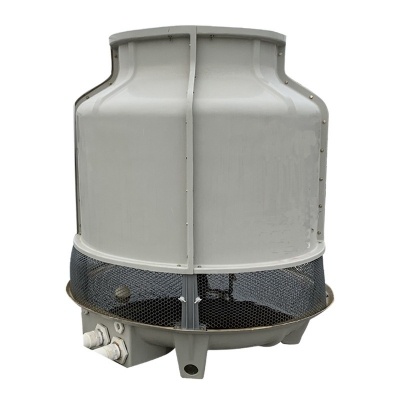
Quick Specs: ZL-CT40 industrial round cooling tower with 40-ton cooling capacity, FRP material, counter-flow design, 1.5kW fan, CE certified. Best for industrial chiller systems and mid-scale manufacturing. The water cooling tower is a device used for cooling circulating water. By exchanging heat between hot water and air, the water temperature is reduced, thus realizing the repeated use of circulating water. Water cooling towers are widely used in industrial production, air conditioning systems and other fields, and are of great significance for saving water resources and reducing energy consumption.
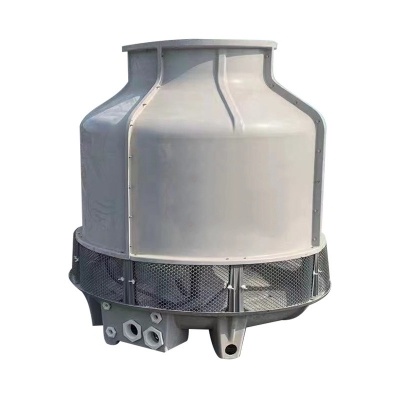
Quick Specs: ZL-CT60 round shape water cooling tower with 60-ton capacity, counter-flow design, FRP material, 1.5kW fan, CE certified. Best for industrial chiller systems and large-scale cooling. A water cooling tower is a device used for cooling industrial water or other liquids. Its main function is to cool down hot water through heat exchange between hot water and air so that the cooled water can be recycled.
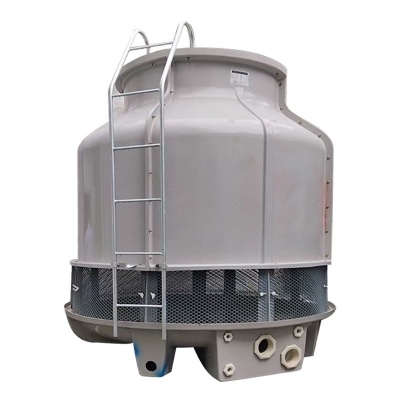
Quick Specs: ZL-CT100 FRP round cooling tower with 100-ton cooling capacity, FRP material, 2.2kW fan, CE certified. Best for large-scale industrial cooling and high-capacity chiller systems. The counterflow cooling tower is a common type of cooling tower. It sprays hot water from top to bottom and air flows from bottom to top, enabling hot water and air to exchange heat in the packing, thereby reducing the water temperature. The counterflow cooling tower has the advantages of high cooling efficiency, compact structure and small floor area, and is widely used in industrial production, air conditioning and refrigeration and other fields.
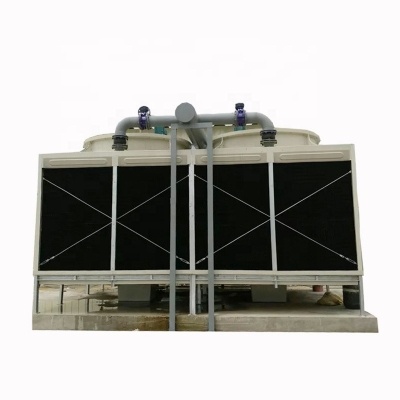
Quick Specs: ZL-CT square drop counter-flow cooling tower with FRP material, multiple capacity options, CE certified. Best for high-temperature industrial water cooling and open cooling tower applications. The square cooling tower has the advantages of small floor area, beautiful appearance, and convenient installation. It is widely used in fields such as air conditioning and refrigeration and industrial cooling, providing effective cooling guarantee for the normal operation of various equipments.
Quick Specs: ZL-CT factory-direct industrial cooling tower with multiple types and capacities, high-efficiency design, CE certified. Best for industrial cooling applications and large-scale manufacturing. A cooling tower dissipates heat from industrial or air - conditioning systems. Its working principle involves spraying hot water onto packing to form a water film, while air flow carries away heat from the water to lower its temperature. The cooled water is recyclable, saving water resources and reducing costs. There are various types, such as open and closed cooling towers. Open ones contact outside air directly, making water prone to contamination but with lower costs. Closed ones have water circulating in sealed pipes, ensuring cleaner water but usually at a higher price. Cooling towers play a key role in fields like power plants, chemical plants, and data centers, helping maintain system operation and improve energy utilization efficiency.
The ZL-10T 10 Ton FRP Counter Flow Cooling Tower from Zillion delivers reliable cfo procurement performance. Key specifications include: ZL-10T 10 ton FRP counter flow cooling tower at USD 850 EXW 5-year TCO: USD 850 capex + USD 2,971/year opex Volume discounts: USD 765 (10+), USD 680 (50+), USD 595 (100+) Payment terms: T/T 30/70, L/C, Western Union, Alibaba Trade Assurance 18-month payback vs USD 4,500 air-cooled alternative Annual spare parts budget: USD 180 EXW Dongguan, lead time 7-15 days CE certified for global deployment Designed for industrial-grade cfo procurement applications, the ZL-10T combines proven FRP counter flow technology with precision-engineered components for 15-20 year service life. CE / ISO 9001:2015 certified. Contact Leika at Leika@gdzillion.cn for quotation.
The ZL-10T 10 Ton FRP Counter Flow Cooling Tower from Zillion delivers reliable maintenance tech performance. Key specifications include: ZL-10T water chemistry: pH 6.5-9.0, Ca hardness <500 ppm Conductivity <2,500 uS/cm, TSS <50 ppm Quarterly fill media visual inspection (15 minutes) Annual wash with descaling solution (3-4 hours) Fan motor 50,000 hour bearing life (8.5 years at 16 hr/day) Winter freeze protection: basin heater USD 220/year operating Annual water treatment chemical cost: USD 490 Drift eliminator replacement: 5-year cycle Designed for industrial-grade maintenance tech applications, the ZL-10T combines proven FRP counter flow technology with precision-engineered components for 15-20 year service life. CE / ISO 9001:2015 certified. Contact Leika at Leika@gdzillion.cn for quotation.
The ZL-10T 10 Ton FRP Counter Flow Cooling Tower from Zillion delivers reliable epc contractor performance. Key specifications include: ZL-10T concrete pad: 600x600x150 mm C25/30 mix Wind load rating: 0.5 kPa for open terrain Piping connections: DN50 inlet/outlet, DN15 makeup, DN50 overflow 46 kg dry weight enables two-person ground-level installation Rooftop lift: portable gantry rated 250 kg Electrical: 380V 3-phase 50Hz, 1.2-1.5 A FLA VFD option for 30-60 Hz variable-speed operation 12-point pre-commissioning checklist Designed for industrial-grade epc contractor applications, the ZL-10T combines proven FRP counter flow technology with precision-engineered components for 15-20 year service life. CE / ISO 9001:2015 certified. Contact Leika at Leika@gdzillion.cn for quotation.


Our company's series of products are well-known in the plastic auxiliary machinery industry for their excellent performance and high cost performance.


 IPv6 network supported


 English
  English
 español
 العربية